I’ve been writing about tabletop games for more than a year now, most frequently in the past six months. Meanwhile, I’ve been writing about the video games (sporadically) for 8 years. I’ve gotten comfortable with the scope and depth of my video game writing, balancing personal experience with analysis, exploring within and around my taste, and finding ways to challenge myself while keeping my footing.
But with tabletop games, I’m still wobbly. My critical angles and the games I manage to write about don’t keep up with the “scene” in a way I can with video games. The critical and the scholarly suffuse into each other in distinct ways with TTRPGs, and even very recent history looms large and casts long shadows. I don’t read enough games, let alone play them, and while I have a keen interest in recent and upcoming work, I simply can’t keep up.
There are a bunch of reasons why it would be difficult to give the “top 10” treatment to tabletop games I’ve played this year. Obviously, there are lots of folks out there reviewing and discussing the newest phenomena within the hobby, but plenty of folks (myself included) spend our time with a “trailing edge”, games from anywhere in the past five or so years that are still filtering into an attention economy that understandably stretches beyond a year-to-year cadence. Often, games I’m writing about are ones I’m only encountering because of prior coverage or actual plays.
So what I’ll do instead is reflect on how I engaged with the hobby in the last year. I want to talk about running and facilitating games, my experiences playing more widely, how few games I read this year, and what became of my first full year of designing and playtesting games. I’ll tie it off with some reflection on writing about games, and some broad goals for the coming year.
Running Games
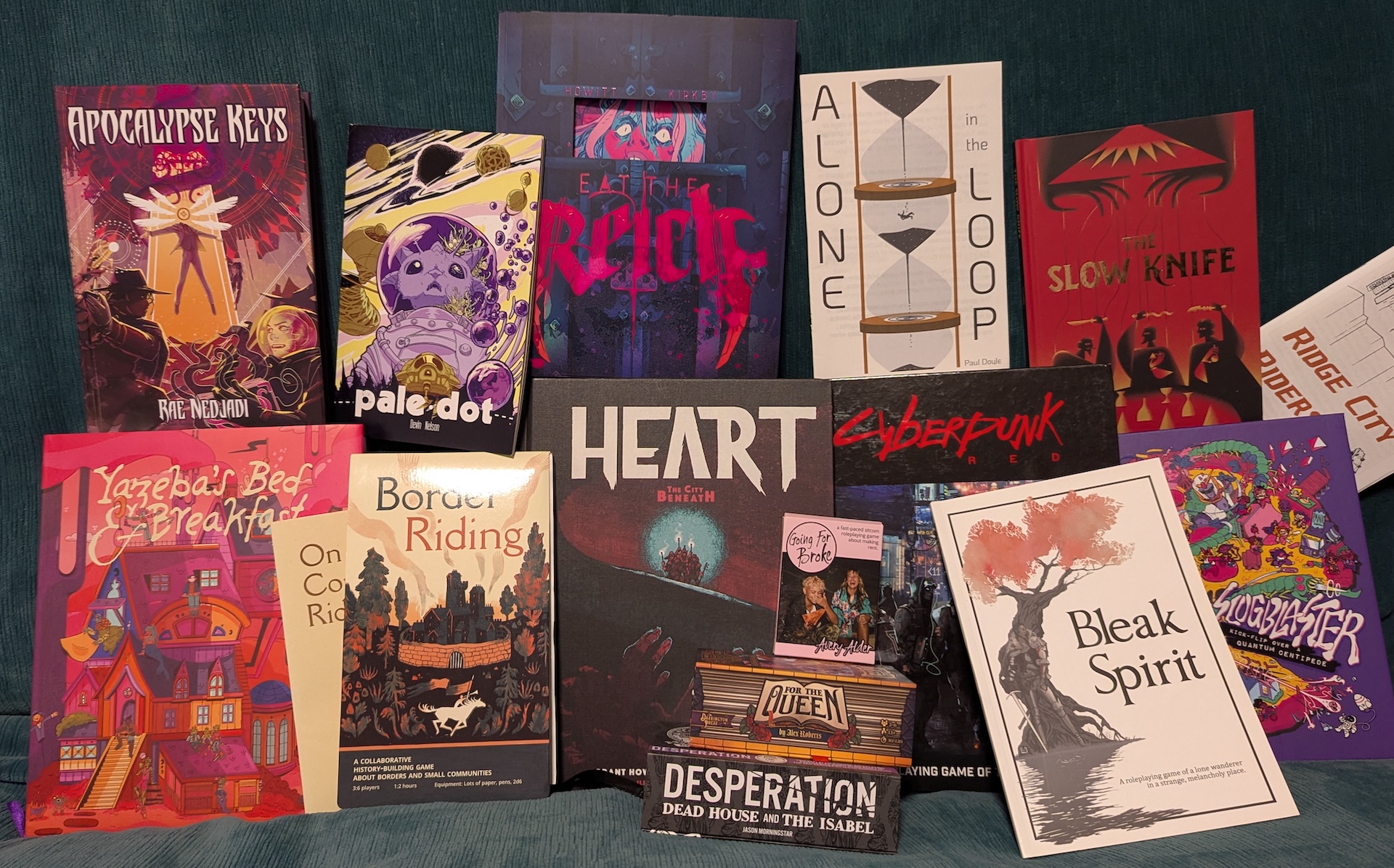
In February I wrapped up a nearly year-long campaign of Apocalypse Keys (Rae Nedjadi, Evil Hat Productions) with a playgroup that’s developed a ton of chemistry as we’ve continued to play together. Running Apocalypse Keys was a great way to flex my growing affinity for horror, and saying goodbye to that campaign on a high note (and after pulling some extremely silly meta-narrative maneuvers) felt like the perfect balance of “hard to say goodbye” and “time to let it wrap up”.
Early in the year, I tried out some of the new Deep Cuts (John Harper, Evil Hat Productions) supplemental rules for Blades in the Dark, which was really challenging to wrap my head around. I started to find my footing as the scenario progressed, but got there a bit later than I wanted to. Still, I had a good time engaging with new play philosophies and learning them together with friends. Deep Cuts marks a pretty substantial leap from the original Blades in the Dark rules as written, but it follows logically from the kinds of play philosophy that makes the original run smoothly. Picking up Deep Cuts gave me a sense of just how differently any two GMs might run the very same game, but it also helped me develop opinions on what works for me and the tables I run games for. I’ve run a decent bit of Blades and don’t reach for it all that often anymore, but Deep Cuts gave me an enticing reason to come back.
Later in the spring, I ran Eat the Reich (Grant Howitt; Rowan, Rook and Decard*)* for the same group. What initially felt like an overly fiddly divergence into very dice-forward play wound up reminding me of something very important: people love to just roll a whole bunch of dice. When Eat the Reich was firing on all cylinders, it was doing a perfect job rewarding both characterful and clever play and delivering the swingy drama of big dice pools. What felt to me like over-reliance on a core set of interactions was in fact—to my players—good indulgent fun.
The last new GMing adventure I embarked on was beginning a campaign of Heart: The City Beneath (Grant Howitt & Christopher Taylor; Rowan, Rook and Decard) for my Apocalypse Keys group, one of three systems I pitched them on that they chose from. Heart started clumsy as we found our rhythms with its Stress and Fallout consequences and the resources necessary to soften them; players were initially appalled at the apparent “difficulty” of Heart, but learned quickly that consequences could be full of flavor, fun, and even surprising new story vectors. I’ve had a wonderful time watching them push their luck, lean into their strengths, and choose Beats that draw the story in wild directions. The party dynamics are bizarre and funny, the characters even stranger. And as we draw towards the conclusion of another campaign I’m having some of the most fun I’ve ever had with prepping and running RPGs.
And finally, I found a couple of opportunities to facilitate Yazeba’s Bed and Breakfast (Jay Dragon & M Veselak, Possum Creek Games), a game that has ups and downs in my opinion but really shines when you manage to bring it to multiple tables, adorn your book with stickers, and start developing the characters. I’ve only played a couple of sessions, but I’m glad I got a binder full of characters started because I think I’ll keep breaking it out now and then.
Playing Games
My home group started a campaign in Cyberpunk RED (R. Talsorian Games), the first brush I’ve had with any version of the Cyberpunk system. Modern iterations of trad games tend to feel oddly bloated to me, a strange mix of old systems and setting details and heavily revised ones aiming to engage new players and surprise returning ones. I have criticisms, to be sure, but I also appreciate getting to play around in a setting that’s more alive and constrained than the sprawling D&D 5e adventures of our previous campaigns. Cyberpunk cares about the mundane side of its characters lives in a way that feels distinctive, even if it it spends a lot of its effort on making mundane life cartoonishly bleak rather than emotionally resonant.
I also spent a good deal of time playing games with a small group for an “actual play” project, which we’re playing and recording up front but will hopefully start releasing some time next year. It’s hard not to split my focus between my own play and thinking about the audience experience, but I always enjoy the clumsy process of building rapport with new groups. I’m looking forward to the challenge of building our play into an enjoyable listening experience and I’m excited about the world we’ve been building together.
I had an opportunity in May to mobilize some friends for a late-stage playtest of Pale Dot with designer Devin Nelson as they worked towards a final release. As silly as it is, I was really happy to see my name in the playtester credits for a printed book, and I'd love to bring Pale Dot to a table some time soon.
In the latter half of the year, I found new spaces and occasions to play more widely. I played convention games at PAX West and KublaCon Fall. I started attending a monthly story games meetup run by a local designer where I played a lot of backlog games like Desperation (Jason Morningstar, Bully Pulpit Games), Going for Broke (Avery Alder, Buried Without Ceremony), and more For the Queen (Alex Roberts, Darrington Press)—which I’ve greatly warmed up to since I first played it at Gen Con last year). I also had the pleasure of trying out Last Train to Bremen (Caro Asercion, Possum Creek Games), which uses Liar’s Dice as a central mechanic and showcases how the texture and tone of traditional games can be a pitch-perfect match for storytelling games. It’s something I definitely hope to explore in my own design.
At KublaCon Fall I also became enthralled with Blood on the Clocktower (The Pandemonium Institute), a social deduction game (not generally my taste) that uses a dedicated facilitator called a Storyteller to introduce all sorts of interesting possibilities to social deduction games that parallel what GMs bring to traditional RPG tables. I don’t know if my fascination with Clocktower will filter into my own design, but it’s left me a lot to think about with regard to why I dislike social deduction games, why I enjoy GMing, and my habits as a player. Folks in story games discourse often seek to soften expectations around GMing, to regard it as a different kind of play rather than a special role beholden to or dominant over the other players. This is, in general, a good thing: GMing is fun and should be taught in ways that make it inviting and approachable! But Clocktower is an unexpected reminder that a GM who is committed to serving and enriching player experiences can bring a lot to a game that would otherwise be impossibly complicated.
I also kept in touch with old coworkers and played a tiny bit of skirmish game Forbidden Psalm (WIRD DESIGNS) and classic adventure board game HeroQuest. I haven’t dug as deep into war games or into board games as I’d like to, but I made a start by trying a few at PAX and playing more with friends over the year. I even took a few faltering steps into Magic: the Gathering. I’m admittedly dissatisfied by how little I’ve broadened my horizons this past year, but it’s good to acknowledge the progress and reassert my curiosity for the wider world of analog games.
Reading Games
This was not a good year for reading games for me. I struggle to set aside time for reading games in the way I can when I’m prepping or playing them, but it is a huge part of engaging with the hobby. Read widely is incredibly enriching and restorative of my enthusiasm for the hobby. Getting to see what the bounty of talented folks out there are getting up to in their latest work is fulfilling in its own right.
One of the only long-form books I read this year (besides Heart, which I’ve been running) was Slugblaster (Mikey Hamm, Mythworks), perhaps one of the most fun TTRPG reads I can remember. With books of this scope, I’ll often read just enough to decide whether or not I want to run the game for a group, and then wait till I have a group lined up before I do a cover-to-cover read. But Slugblaster just kept my attention, made me laugh, and had me constantly grinning at its zany locations and factions and equipment. I adore its stylized writing and in-universe voice; it was a big inspiration for one of my own ongoing projects.
Beyond that, I read a few games here and there that I’ve bought or have been gifted in the past year or so that I found compelling. Bleak Spirit (Chris Longhurst) takes the idea of a “Dark Souls story game”, which is tantalizing to sickos like myself, and leans deeply into notions of enigmatic protagonists and speculation-as-play—aspects that surprised me at first but feel sharp and well-considered in retrospect. The Slow Knife by (Jack Harrison, Mousehole Press) sounds like an absolute blast to play, a conspiracy-building story game built on the spectacular premise of perfect, patient revenge. Border Riding (Jo Reid, Stout Stoat Press) is a thoughtful rumination on how borders change our perception of ourselves and others, an incisive evolution of ideas in story game classics like The Quiet Year. It comes with a companion essay that imparts some history and eloquently expands on its key themes. I’m not sure if I’ll get any of these to a table any time soon, but reading and thinking about them has already been time well spent. Reading widely keeps me inspired by the hobby, especially at times when I can’t get a play group together (and maybe don’t have the social energy anyway), and I need to do more of it next year.
Designing and Playtesting Games
This was my first year of (somewhat) full time game design, and it was a daunting prospect at the start of the year. I started the year with the goal of getting one of my first serious projects out into the world in January: Alone in the Loop, my hack of Alone Among the Stars (Takuma Okada) that tells the story of a lonely time traveler trying to prevent a grim future. It was with the enthusiastic help and encouragement of friends that I found the confidence and motivation to complete the layout, publish it on itch.io, and eventually even put a modest price tag on it.
But beyond the simple milestone of releasing something that felt finished, the work I’m proudest of this year is all the design and iteration and playtesting I’ve done. I have many more milestones to hit (more on that later), but I’m very proud of just how much design and community participation I’ve mustered this year. I’ve made a couple of friends in the scene, deepened my connections with others who I’d only met peripherally, worked with very talented folks, and ultimately found more solid footing within my own creative process.
I also reached out further and tried to participate in more TTRPG community spaces, becoming active for a while in a couple of discord servers before slowly burning out from the cocktail of social anxieties they seemed to draw out of me. I still try to lurk from time to time, but I’ve curbed my participation and attempts to “keep up” in order to protect my own mental state. The experience has, unfortunately, given me some pause when it comes to how I approach participation in the communities around this hobby. To be clear: nobody has done or said anything to me that targeted me or excluded me. But I’m learning that these spaces tend to stress me out unless I maintain a degree of remove. I hope to cautiously reengage in the new year, but it may be a mode of community participation that just doesn’t quite work for me, and I hope it’s not too much of a barrier to finding friends and collaborators in the future.
Regardless, it’s a year to be proud of. I did a ton of prototyping during my ill-considered dive into an October daily design challenge, I’ve playtested 6 different projects, some even with groups of strangers (which was incredibly daunting at first), and I’ve picked up a lot of instincts for layout and organization of my work as I went.
Writing About Games
Finally, the most ridiculous and circular part of this post: where I write about tabletop games by reflecting on my writing about tabletop games. Halfway through this year, I adopted a more aggressive and consistent blogging cadence with the goal of improving my writing and analysis through consistent practice. I’ve written a lot that I’m proud of and a lot that felt half baked, and I’ve fretted an unreasonable amount about the four total emails that get sent out to subscribers when I hit publish (if you’re one of them, hello! I appreciate you immensely!).
My favorite work is still my longer essays about planning for and running specific games. I’ve also greatly enjoyed writing design commentary pieces for my own work, but I don’t necessarily feel like they’re as insightful in their own right. I hope to get better at talking about design from a designer’s perspective, but I hope that comes with time, practice, and confidence.
Nonetheless, my conclusion is that the pace I’ve adopted is a bit too aggressive—especially with my propensity for high word counts. For next year, I’m aiming to post every two weeks, continuing to alternate between TTRPGs and video games. Hopefully that strikes a balance between consistent output and time collect my thoughts.
Farewell 2025
It’s been a busy year, but next year will be no less busy. I’m sticking with pretty broad goals for now, but I hope to:
- Release Ridge City Riders, the project that I started in March. It’s the first time I’ve brought on an editor and an artist and they’ve already helped make it so much more than it initially was. I’m really excited about this one and it’s almost at the finish line!
- Playtest more and with a wider crowd, including soliciting playtesters in game design communities.
- Run something at a convention, either something of my own or just something I enjoy running.
- Run something in the OSR space (let’s be honest, this will probably be Mothership).
- Read more RPGs this year, including a few longer ones.
And that’s the year! A lot to write about, but still so much to play and read and build in the coming year. To all of those in the hobby who I’ve gotten to know or work with or play with during this year: thank you for making me feel welcome, for sharing your art, and for engaging with mine! Here’s to another year of strengthening those bonds and sharing my love for this art form and community.