Over the past two Wednesdays, I ran a short game of Deathmatch Island with my regular gaming group. As I’ve run games with this group over the years, I’ve begin to see a pattern: with very rare exception, I have a lot more difficulty running a satisfying one-shot (in my own opinion) than I do with short, 4-6 session campaigns. Deathmatch Island brought this into focus in a way I hadn't considered before.
What is Deathmatch Island?
Deathmatch Island is a game by Tim Denee based on the PARAGON system featured in Sean Nittner and John Harper’s AGON (disclaimer: I’ve not played AGON at all, nor have I read it; this was my first brush with anything PARAGON). It’s about a group of people ripped from every day life and forced to compete in a mysterious death game across a chain of islands. The game is about competing for resources, forging alliances, and finally testing your capabilities and loyalties in lethal combat...or, if you can get on the same page, unraveling the game itself and defying its rules.
It’s a procedure-heavy system based around a roll-all-at-once resolution mechanic called “contests”, designed to cover all the action of a single situation, usually a reality-TV-style challenge or an encounter with an NPC alliance, often both. The game provides maps for all three islands, each one including a set of nodes to explore and rewards to uncover at each. Since conflicts are resolved with One Big Roll, the game follows a prescribed structure: in phase one, players explore nodes and vie for resources; in phase two, they take on a sequence of contests to position and then fight in a battle royale; finally, when the dust settles and the competitor pool has been whittled down, they travel to the next island and have time to recover from injuries, recount memories of their past, and craft theories about what’s really going on. After three islands, they move into an endgame where, based on the results of a modified prisoner’s dilemma, they either fight to win or cooperate to dismantle the system. That’s the full version of the game, anyway.
In this way, Deathmatch Island is a big set of procedures around repeating a singular core mechanic: a dramatic contest involving each player’s relevant skills, background, advantages, and accumulated resources. Players build all these details into a dive pool and then roll all at once, each aiming to beat the target number determined by the GM’s establishing dice roll. The rest of the game’s rules are about what to do next, who will be encountered on the island, when to move on, and where and how to manage progression, recovery, and theory-crafting.
The “One-Shot”
I ran our game on Roll20 across two weeknight sessions, each one roughly two and a half hours long. I refer to it as a “one-shot” here because our approximate total of four and a half hours feels like what you’d dedicate to a more typical one-shot session. Admittedly, having the game broken into two short sessions with a week in between (during which I could revisit the book at my leisure) made a big difference on how I prepared and how it played out.
During our first session, the players got through character creation, made a decision about their first node destination, and briefly met a group of other NPCs, whom they started clear of. We ran the first contest—slowly, to make sure we got the details sorted out—and claimed some rewards. We covered maybe 25% of the one-shot procedure, even the abbreviated version of it. But it wound up being important for me to realize how much I was stumbling over the core system.
The second session moved at a better clip. The players explored three more nodes and encountered two more NPC fractions. Once we shook off the dust, it was easy enough to build dice pools and work through contests. By the time we finished these nodes, the players had a handle on the core ideas, had spectacularly failed a couple of nodes, and had used a REDACTED reward to sneak easily into the last node.
Our time was running short, so I offered the players two options: play phase two, in which they’d need to manage alliances and thin the competitor pool on the island, or montage past that and play out the end game with just our four players as the final contenders. We opted for the latter. During the end game, one of the four characters decided to play to win rather than work together to break the game. In the last moments, she did.

Challenges
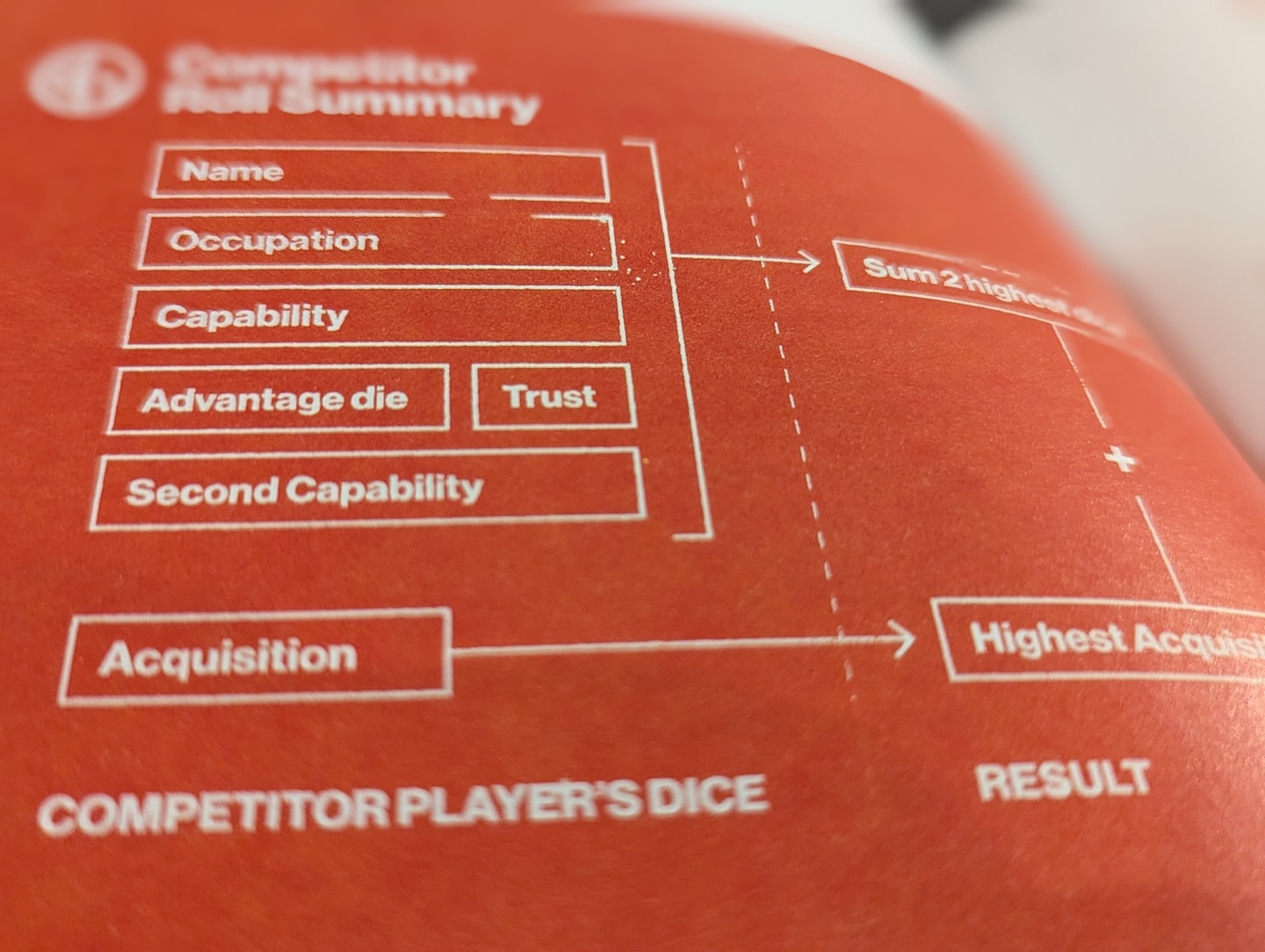
This streamlined resolution mechanic works reasonably well once everyone is acclimated, but since it’s so load-bearing, it also turns out to be quite the tangle of little details. Every die contributed to the dice pool comes from a different spot on the character sheet and has different circumstances for its inclusion. There is a “push yourself” mechanic to incur Fatigue and add another die. There are Advantage dice, a nebulous catch-all for GMs to award to players or NPCs. There are Acquisitions, inventory items rewarded from prior contests, which are added to the final total instead of pooled with the rest. Some Acquisitions change the stakes of the challenge, and REDACTED Acquisitions have special rules about when and how they can be used. There are two different ways for players to help each other, each with different tradeoffs and fictional positioning.
The GM section has great advice for the social and storytelling aspects of the game (and a very handy procedure for one-shot sessions), but it doesn’t offer much guidance on teaching and managing this core system or contending with its fiddly details. Yes, it is technically a mechanism for resolving a whole situation with a single dice roll; but that single roll is composed of seven or eight distinct decisions to understand and consider.
Frankly, the heft of this core system was not clear to me until we began play and I began trying to explain each step, each optional tradeoff. The Roll20 module (easily the most lavish official modules I’ve seen for a story game) steps through a sequence of dialogs that are about as elegant as one could hope for, given the limits of Roll20’s interface. It does, after a time, click into place. But it’s designed so that a huge portion of the game’s mechanical ideas comes into play for the first time all at once, even if you might gloss over aspects like Acquisitions and Advantages that aren’t available at first. This front loading can be overwhelming. The intended shape was ultimately clarified for me by supplementary tools: the excellent flow charts accompanying the rules text, the play example, the Roll20 dialogs, and (primarily) watching an actual play in which Tim Denee himself ran the game.
Figuring out how to interweave the cast of NPCs into the challenge nodes on the map was another stumbling block, one that made the first node clumsier. On top of that, I couldn’t get my head around “confessionals.” This is the name given to the part where each player narrates what happened to their character in the scene based on their dice result. The term “confessional” refers to a specific kind of filming and editing technique in which a subject of a clip is interviewed after the fact and addresses the camera directly. But in this rulebook, the word is used only as a dash of flavor that evokes reality TV, not as an accurate descriptor for the step of play that it describes. For some reason, this incoherence really bothered me; I got a bit lost trying to make sense of a framing device that wasn’t really intended. Once I understood the scope of play and came to realize that players doing “confessionals” could narrate in any way they liked, it was easier to move in and out of contests.
Takeaways
There are really cool ideas in Deathmatch Island that I’d love to see more of in play: I’m curious how more time together could form stronger bonds between player characters and promote more alliance-building and politicking, and I wonder what strange mystery my players and I would build together when theory-crafting between islands. I loved the speedy character creation and the randomized Motivations, which are kept hidden and used to inform roleplaying decisions when starting out. The final duels have a special procedure for narrating their outcomes, in which the loser can delay defeat indefinitely by explaining how they barely hang on, forcing their opponent to deliver another heart-wrenching death blow, until the loser is finally ready to surrender their character; it’s exquisitely dark, brutal, and evocative. Several players in my group expressed interest in revisiting the game in the future when we break from other long-running campaigns. I hope this isn’t the last I play of Deathmatch Island or its system.
But as with many games designed for multiple sessions, the totality of Deathmatch Island’s ideas do not fit into a one-shot. The tradeoffs provided allow a group of players to sample the core themes of the game, a vertical slice that conveys the most important elements, and leave players and GMs curious to play more. But this filtering process is no small task, and it’s even more difficult to do on the fly as you determine what to include and what to skip past. Deathmatch Island’s overall structure is easy to skip around, but it’s all-inclusive core mechanic touches so many little corners that might feel conspicuously absent or entirely extraneous if you skip the wrong steps.
I can think of very few new games I’ve run where I had a strong grasp on their system, or even a fully-formed opinion of the game, before session 4 or 5. It’s difficult to see enough of a game’s systems in a one-shot, especially when running it for the first time and still building familiarity, but it’s also difficult to pare that down effectively without experience. Prepping a smooth and successful one-shot is a very different task than learning how to GM a game, and it’s an ambition I should consider reserving for games I know well.
One exception is Slugblaster by Mikey Hamm, which is not only delightful to read, but is also alternatively available as a demo version called Slugblaster Turbo X, which reformats Slugblaster into a three-page introductory one-shot. It was undeniably useful to have read the full game before running the one-shot, but having a much smaller rules and reference surface made it so easy to run smoothly. Adapting a game for one-shots by carving away 98% of its text and distilling into a precise subset of self-contained rules and scenario is admittedly lot of work on the designer’s part, but the effort did not go unappreciated.
Despite being a generally positive play experience, running Deathmatch Island left me questioning my approach to learning and sampling a wide variety of games. No reasonable amount of preparation feels like enough to run a smooth one-shot with a game I don’t already know; I’ll always be learning or clarifying things along the way as I run the first couple of sessions. Is this a skill I can develop with practice? Or would I be better served by deepening my curiosity and committing more often to short campaigns?
It’s hard to say. Trying, stumbling, and then finding my footing in Deathmatch Island wasn’t so different from how I’ve learned to run other games, but it left me with little time left to enjoy the fruits of my play group’s eventual confidence. And though, some of these difficulties arise from the elaborate structure and focalized complexity of the PARAGON system, I hope it’s also just one more play experience I can learn from.