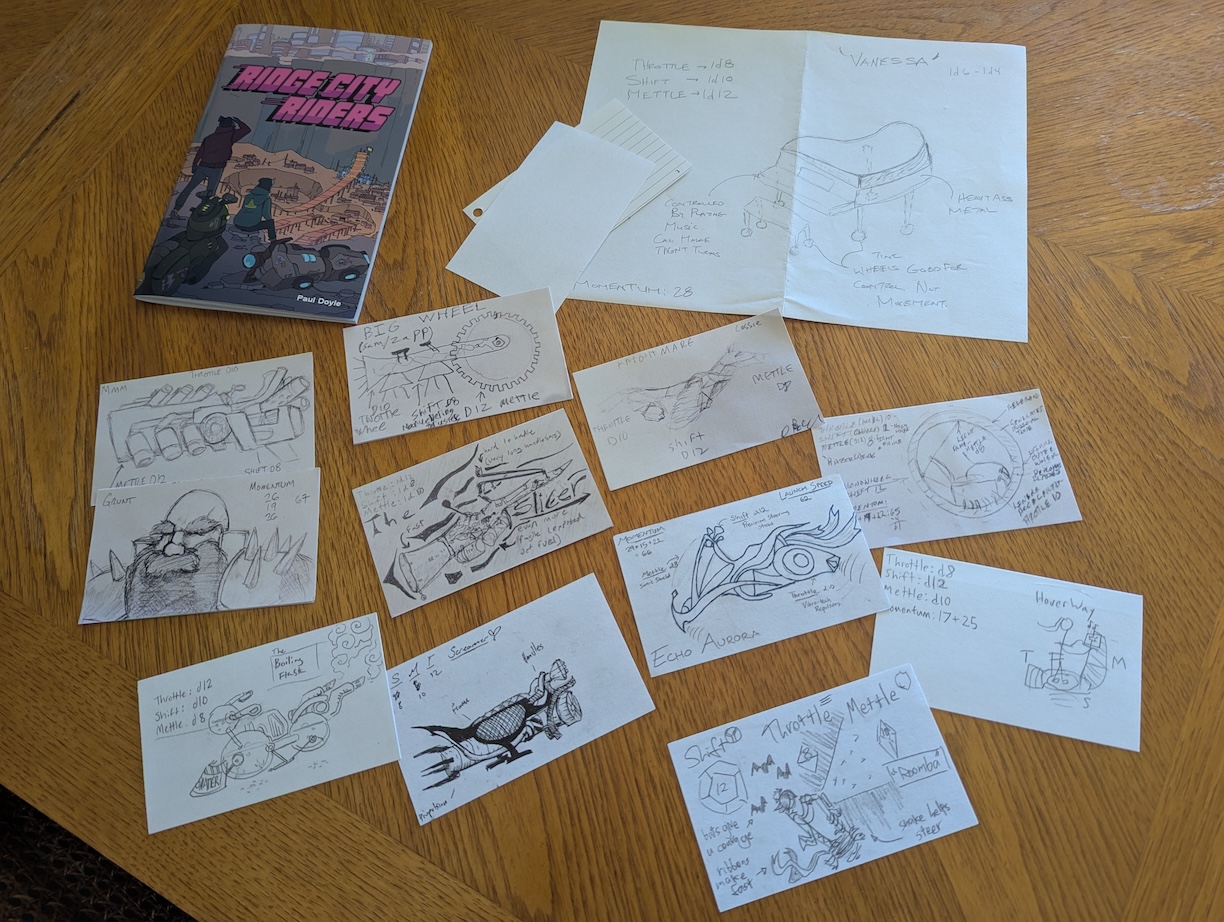
A couple weeks ago, I posted a short thread on Bluesky about running Ridge City Riders, my game about hoverbike riders on a death-defying run through a scrapheap city, and some observations I've made about how players interact with it. Mulling it over some more, I think I have some broader thoughts about it. Relatively quite few TTRPGs that I've encountered prompt players to draw things. They sometimes encourage or suggest it, but within my sphere of familiarity, it's rare to find games that directly instruct players to draw in the same way that they might tell players to fill out a character sheet or describe actions in play. I want to interrogate, at least from my own experience, why I think drawing might be seen as too much to ask, and why I think it has potential as an act of creative expression that can fit into roleplaying games.
What Draws me to Drawing?
I don't think of myself as much of an artist. In the past couple of years, I've tried to build a foundation for drawing and digital art, but my intention is to invest in the practice gradually. Practicing and improving at visual art is valuable and worthwhile work, but my priorities divide among other things. I'm not an idle doodler, either. Despite personally lacking comfort with it, I've taken an interest in how the act of drawing can function as a different mode of both synthesizing and expressing ideas in storytelling games.
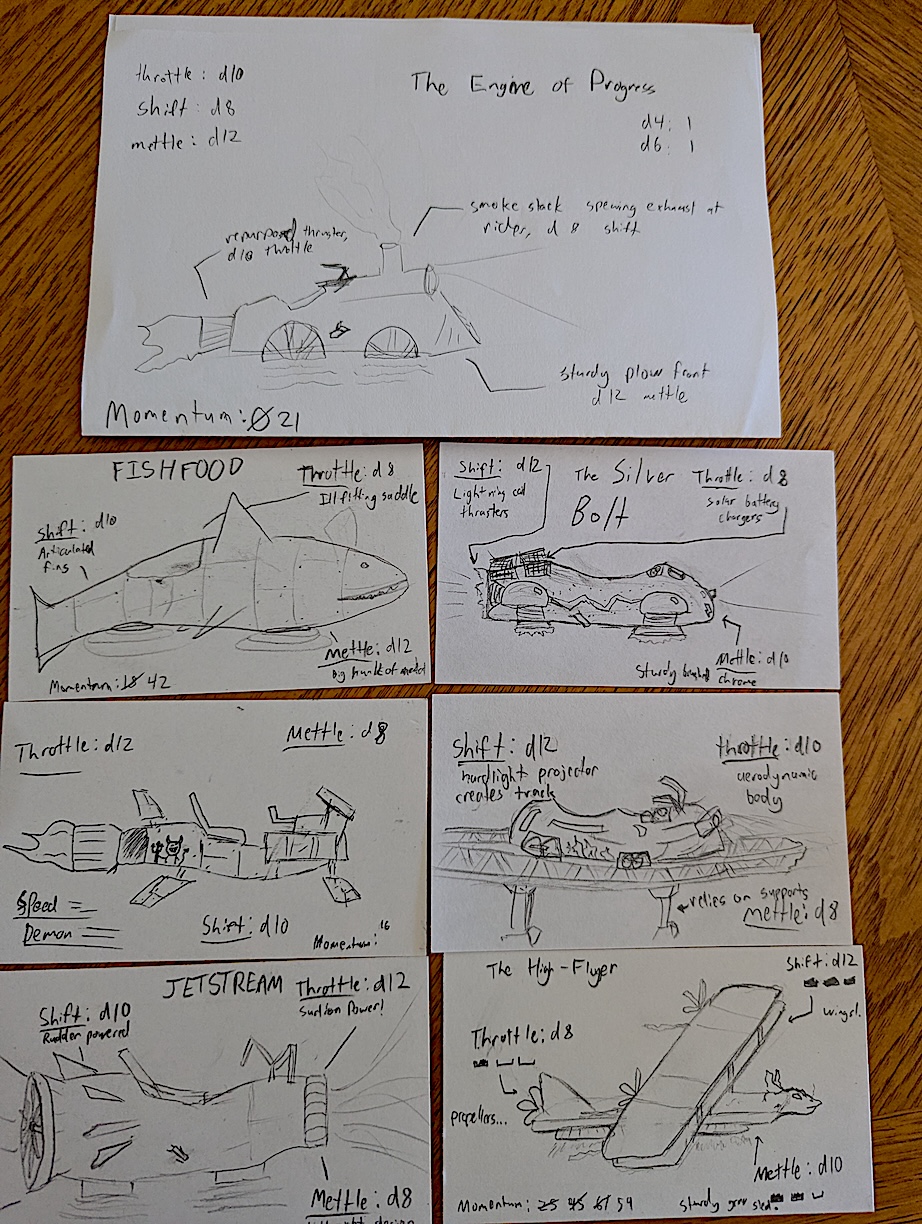
When a player sits down to draw something on the page, they often start thinking about character, setting, and context in new ways. In Rigde City Riders, the first step players take is to draw their hoverbike, a custom built machine made of scavenged scrap that they'll spend most of the game thinking about and describing as they speed through the city. When you start drawing a hoverbike, you might consider details you otherwise wouldn't. What materials does my character have access to? What kind of propulsion or levitation technology is out there in this world? Why were these parts thrown away, and how have they been repaired or adapted to make them useful? These kinds of questions can surface fruitfully at the moment when players need to put something visual on the page, leading them to think in terms of grounded concerns that, intentionally or inadvertently, introduce detail to the world. I'm not convinced that asking players to describe their bike in words would have the same effects.
For some players, drawing is also a passive background activity, a fidget that helps them stay focused or present and away from other distractions. With Ridge City Riders, adding detail to your bike can mirror the implied in-character act of tinkering with a bike design, an activity that draws players more deeply into their character and into imagining the physicality of their hoverbike. Some players might be prone to idle doodling anyways, but I like that Ridge City Riders provides them with a more specific canvas for that impulse.
Still, drawing is widely understood to be a skill, in which some people have more experience and training than others. In a quick survey of games I'm aware of that include drawing mechanics, I found a few patterns that come up that I might call "reassurances": contextual aspects of the game and its drawing tasks that alleviate the pressure to make "good" art and make the game more approachable to non-artists.
Reassurances
Perhaps the simplest reassurance a game can provide is the promise that nobody else needs to see your art. Games that prompt the player to draw are substantially easier to find among solo RPGs. When the exercise is purely personal, it's much easier to enjoy the process without fretting about outcomes or judgment.
Not only are solo games entirely private by default, they're also paced by the singular player. Solo players might be beholden to the available time they have, but their pacing does not need to align with anyone else's schedule. Giving a player privacy removes the social pressure of performing any particular task to external standards, speed included; it seems reasonable to expect that a solo game with drawing is far less daunting than one with other players waiting for you to finish.
Some examples of solo journaling RPGs that involve drawing:
- Artefact by Jack Harrison
- Two-Hand Path by Mikey Hamm
- Exclusion Zone Botanist by Exeunt Press
- A Collection of Improving Exercises by Tim Hutchings
- A whole bunch more according to the tags
When multiple players are drawing at the table, it's not uncommon to see a another form of reassurance: abstraction. One of the most common forms of drawing mechanics in multiplayer games is map-making. Maps are abstract representations of a world that is far more detailed and complex. Sketching an oval with some vertical lines to label a mysterious sinkhole in The Quiet Year or penciling in a series of triangles to represent a mountain range in Cartograph can probably be considered easier tasks than drawing a character's face or a specific object in enough detail to identify it.
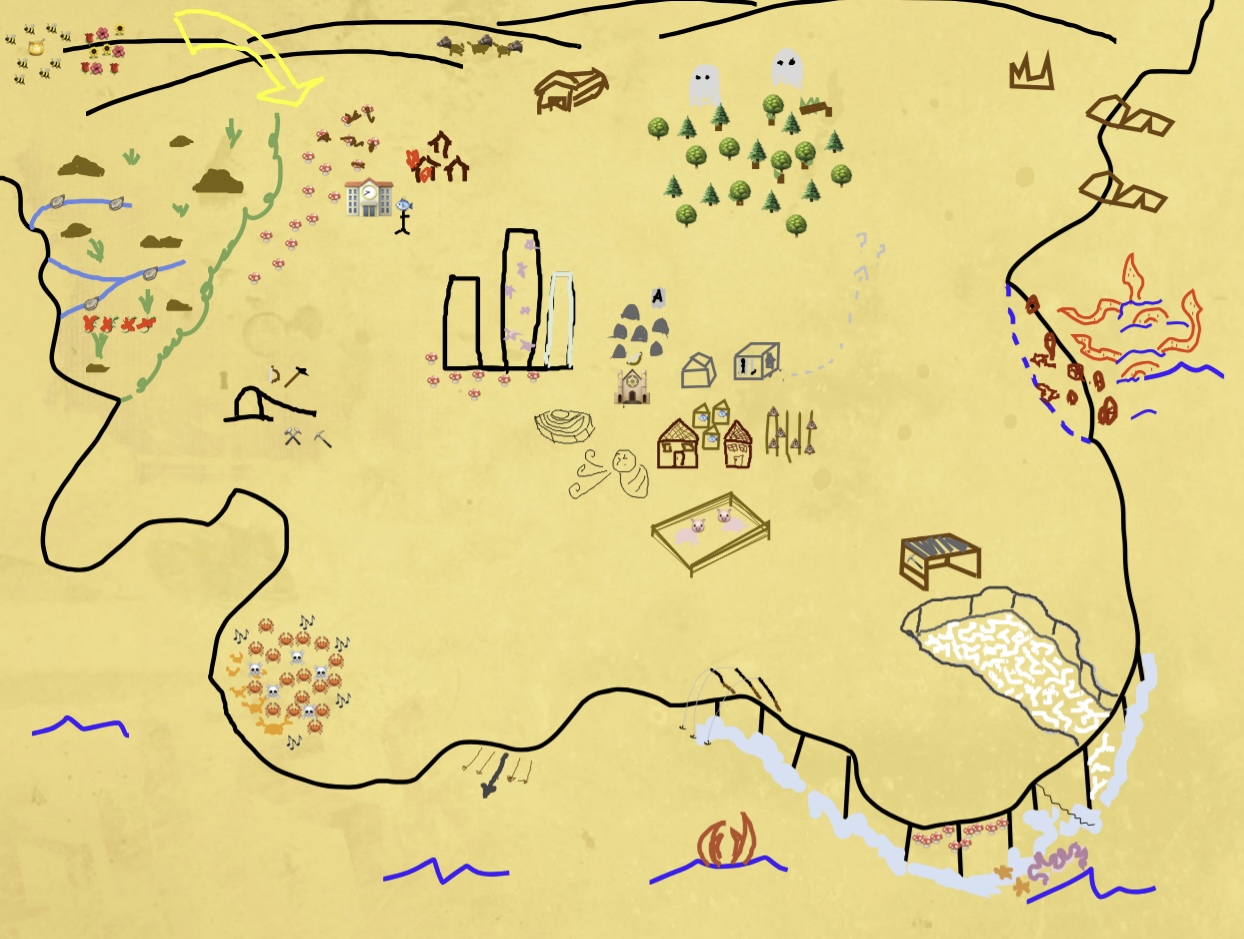
Mapping redirects the significance of a drawing from its visual quality to its representational qualities, like where it's placed on the map and what it's meant to signify. Drawings on a map don't have to be depictions; only representations. These games typically also instruct players to describe what they're drawing to fellow players; their verbal description is the core contribution. The drawing, then, serves to remind everyone at the table of whatever they imagined when its subject was introduced verbally. There is always a gap between a work of visual art and the imagined object or place it represents, but abstractions like map-making amplify that distance and give players extra permission to be loose, gestural, and brief with their artistic efforts.
Some examples of map-drawing RPGs:
- The Quiet Year by Avery Alder
- Ex Novo by Martin Nerurkar and Konstantinos Dimopoulos
- Cartograph by Brandon Lee
- Border Riding by Jo Reid
- An Altogether Different River by Aaron Lim
- And some more according to the tags (though they vary between "mapping", "map-drawing", "map-making")
Drawing and Game Feel
One of the only multiplayer TTRPGs I've encountered that asks players to draw objects, not just representations on a map, is Moonsailors by Annamyriah de Jong. In this game, you play as lone spacefarers in a declining star system. You'll sketch your character's spaceship on a scrap of an index card, and occasionally sketch small objects that your character finds or leaves behind at the places they visit. One reassurance provided by is that your drawings are necessarily small and quick, and while they're less abstract than map markings, they're still representative: they move around the representational space of the game, indicating where objects and spaceships are at any given time. Sketching little ships and objects isn't critical to how the game works; in fact, the rules only suggest drawing instead of writing a few words. Nonetheless, drawing objects changes how it feels to find something or leave something behind, and adds a tactility and physicality to the space and the objects being represented. It makes the emptiness between things on the table feel more pointed: in a setting that's populated with objects and people, isn't it stark how few there are? How lonely this place is?
This might be a small detail, but I doubt that I'd feel quite the same effect if these were not hand-drawn objects on scraps of paper. It's important that they're drawings; they signify the lingering presence of another person, highlighting both the loneliness of the setting and the evidence of other people coming before, allowing the stories to intertwine. They might be less poignant symbols if they were words on a scrap of paper.
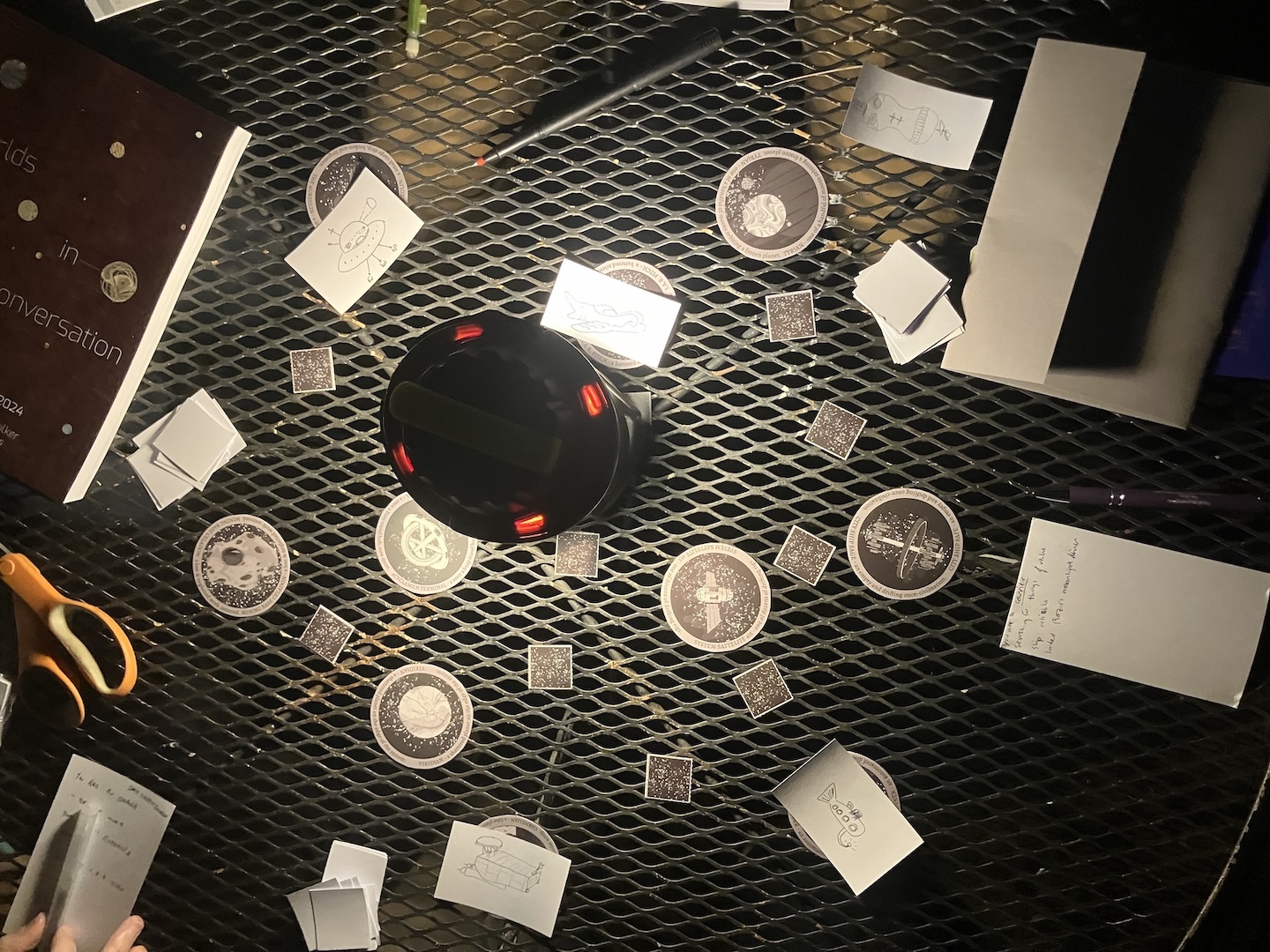
The term "game feel" is typically used in the context of video games, but a similar notion applies with TTRPGs. How a game engages players physically, what it asks them to perform or embody, is also affected by the expressive media they ask their players to use. Inevitably, different media will produce different intangible experiential qualities. A Mending by Shing Yin Khor flex the format of a solo TTRPG by tasking the player with weaving thread through cloth. Sock Puppets by Kurt Refling begins with a call for each player to find or make a puppet, and to take as much time as needed to do so. The game then plays out via role-played puppeteering performances, which has its own unique feel compared to role-playing without puppets.
Sock Puppets (rightfully) insists that making puppets at the beginning of the game is part of playing the game. And yet, the book itself has fairly brief advice on how to make a "good" puppet; it recommends some easy materials to get you started, but it doesn't tell you what you ought to do with them, how to make any particular shapes, or what to paste where. The game exudes confidence where players may not; it simply assumes that even someone who is unsure of their puppet-crafting skills will ultimately come up with something unique and delightful. I've yet to get Sock Puppets to a table, and I haven't made a puppet in at least 2 decades, but somehow I trust that this assumption will bear out. Reassurances are important and useful, but so is trusting in player creativity and enthusiasm.
A few games that ask players to do other uncommon creative tasks:
- A Mending by Shing Yin Khor
- Sock Puppets by Kurt Refling
- Ribbon Drive by Avery Alder tasks players with building playlists (though it's before play starts)
Is Drawing Different?
In TTRPG design, especially in world-building and scene-driven games, prompting players to make creative contributions is a core element of play. Tasks like inventing setting details or role-playing a character in a scene are standard to this corner of the hobby, but those tasks can push players out of their comfort zone just as much as asking them to draw might. In most cases, even inelegant or unpracticed contributions are welcomed wholeheartedly. Are the expectations around ideation and improvisation more solidified, or is there something fundamentally different about drawing?
It's possible that game designers gravitate towards roleplaying and writing just because they are also roleplayers and writers. But that doesn't mean we don't offer reassurances for those more familiar mechanics too: plenty of games provide examples or pick lists, or encourage collaboration, when they ask players to world-build. Games that ask players to roleplay scenes often have advice or suggestions to make framing scenes and portraying characters easier or more comfortable. Approaches do vary, but a great many games acknowledge that these are creative tasks, and that some players will benefit from advice or encouragement.
I won't pretend that my familiarity, even in the "story games" niche, is complete enough to back all my assertions here. But it does feel notable to me that when I included the hoverbike-drawing step in Ridge City Riders, I didn't give it much thought. Even though the only games I'd played by that point that involved drawing were map-making games, it still felt like a natural thing to add. Only in retrospect did I consider how uncommon it is to ask players to draw a vehicle.
But that should change! It can be rewarding to ask players to perform a wider variety of creative tasks at the table. There must certainly be players out there who feel like they're better artists than orators, or better at sketching than scheming. I'd love to see games keep challenging players to creatively improvise in all manner of ways, even if they're uncomfortable or alienating to some audiences; we're all richer for the expressive variety. With frameworks that balance reassurances with trust, I believe we can still make those games as welcoming as possible.