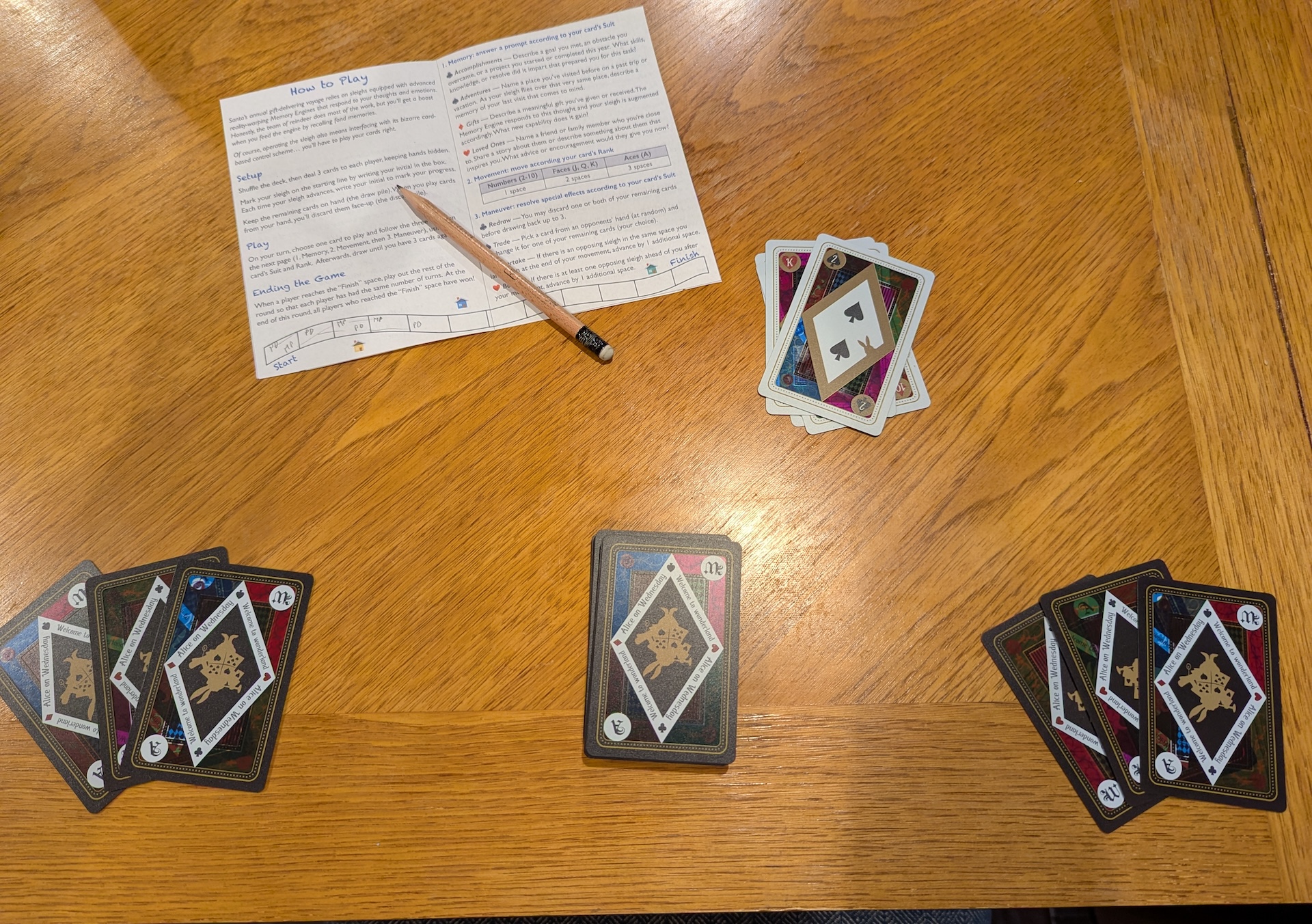
Last year, I made a one-page holiday TTRPG to send out with Christmas cards to friends and family. It was a simple trick-taking game tucked into a silly pretense about taking over for Santa on Christmas Eve and delivering gifts in a fleet of time-manipulating sleighs. The premise is explained briefly, the core rules are condensed onto one spread, and it dedicates a back page to a play example; generally, I think it fits itself pretty well into a little gift-wrapped box of design constraints. It’s free and a quick read, so I encourage you to take a peek at it on itch if you’re curious!
This year, I’ve decided I’m going to try to cement this into a tradition and make another one-page holiday game. It’s a delightful design challenge, a fun way to experiment with scale and format, and a nice way to vaguely explain to friends and family what this whole “game design“ thing is about.
So, what exactly are the design constraints that I’ve established for myself, and what’s the philosophy behind them? I’m so glad you asked! Here are the design guidelines for Holiday Games:
- Sharing memories is a core theme — Sleighing Time was a little on the nose about this, but its central idea was to nudge players into sharing memories of loved ones, stories about their travels or adventures, or goals and accomplishments. It was built around the idea of catching up with friends and family during the holidays and looking back on the year. I hope to carry that theme forward in a novel way this year.
- Highly approachable — Holiday games are designed to be shared with friends and families ad hoc during the lazy in-between hours of visits and gatherings. That means that they need to have trivial play materials, flexible player counts, and a short runtime. Sleighing Time can be played with a deck of cards and writing implements, which imagined most folks having on hand. Items like block towers, specialized dice, or even 6-sided dice felt a little too specialized for average non-gamers to go dig up. Other widely available implements like coins or sticky notes would also be reasonable choices. In addition to materials, Holiday Games should play comfortably with 2 or more players, probably becoming less reasonable at about 6+. Sleighing Time felt viable even for just two players, like a couple enjoying a quiet evening together before traveling to visit family, but I can imagine it dragging with 5+, so I’m hoping to improve the scaling factor for this year’s game.
- Low floor for roleplaying — In Sleighing Time, players are asked to play as their real-life selves, but placed into a silly fantastical scenario. Since it revolves around sharing your real-life memories, it makes perfect sense to play as yourself. There’s no reason folks couldn’t assume a character and invent memories, but it was important to me that it not be an expectation. TTRPG gamers delight in Making Up Guys, but to me it was helpful to lean into the more casual reflex to simply play as yourself. Holiday Games that do involve playing as characters other than yourself ought to provide simple pre-gens or straightforward archetypes to make sure they’re easy to pick up.
- Influenced by board/party/traditional games — Sleighing Time includes a little track along which players race to the end, reminiscent of board games, and involves a lightly competitive layer in which players can overtake each other or exchange cards. These details are intended to make the game feel more familiar to folks who aren’t accustomed to storytelling games; a ludic goal like “win the race” gives a simple framework for decision-making if players aren’t drawn to the storytelling prompts. Crucially, Sleighing Time also includes rubber-banding mechanics to keep the race close and an equal-number-of-turns rule that allows multiple or even all players to win, together. The ability to gently compete—but with the potential to bring everyone into the winner’s circle—struck a nice balance in my mind between a competitive impulse that motivates play decisions and a set of equalizing measures that keep the stakes low and the game close.
- Simple, but not boring — Designing for non-gamers means relying on a narrower lexicon of rule vocabulary and zero assumed knowledge of RPG systems. Sleighing Time’s rules needed to fit in one spread so they’d be easy to read quickly and could be referenced during play. The progress track adorns the bottom of the same pages, so everything is in one spot. The front and back “covers” were reserved for the establishing fiction and a play example, both less likely to be actively referenced. The rules, while condensed, still have a light dusting of strategy and storytelling prompts to produce the intended social dynamics. They’re simple enough to follow by referencing the instructions, but not strategically inert and with storytelling prompts that ought to make players think for a moment. There are certainly some ambiguities and edge cases, but I feel like it works well for the space it uses.
Looking back at Sleighing Time, I still feel like it lives up to these goals. For this year’s game, I have similar goals in mind, but I hope to make something a bit more ambitious. We’ll see how it turns out.
If you’re a game designer, I invite you to (informally) join me in making a holiday game! Share whatever you make, or reach out and let’s exchange cards. If I keep this up, I ought to put together an itch.io game jam in the future.