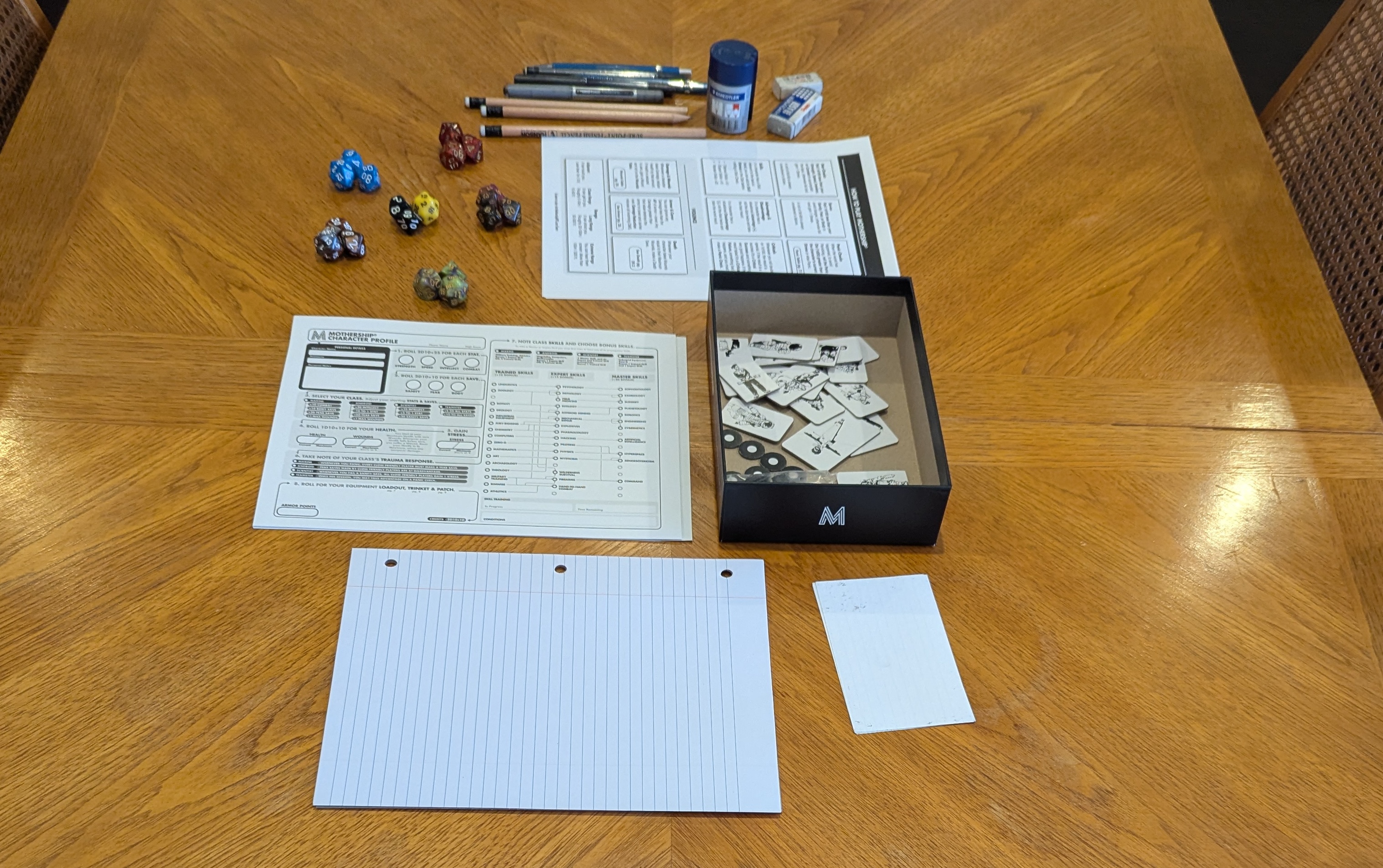
At the beginning of the month, I got my long-running tabletop group together for an incredibly overdue in-person session. Knowing I’d have more time than a usual session and wanting to explore more kinds of games, I read up on Mothership, printed out materials, and set up the box full of goodies that come with the game books. I bounced around skimming various modules, but figured I’d get the most straightforward new-GM experience running the first scenario in the pack-in module Another Bug Hunt. Our session went for about five hours, and we concluded it with (some small spoilers) the mission completed—files retrieved and hostiles dispatched—, one player character dead, and most of the others infected with the strange affliction that’s central to the whole mess. We ended on a stinger that suggested that the transmission that called back the dropship to evacuate the party had infected the pilots, and possibly others aboard the ship in orbit.
This was my first time running Mothership and my first time running anything in the OSR space, though I have played a few OSR games before. I wasn’t sure how to tune my expectations for how Mothership would function in this context and with this group of players. It should go without saying that even if I happen to have an academic understanding of OSR principles and playstyles (which is also disputable), I could stand to learn a lot from more experience.
But before I can explain how I felt about the session overall, I should give you a bit of backstory.
My Cool And Edgy (Gaming) Backstory
I first dabbled with TTRPGs in college, where I played short campaigns of D&D 4e or 5e here or there. After I graduated, I played a couple more short campaigns as well as a Call of Cthulhu campaign with coworkers that went on for about a year and a half. I listened to D&D comedy podcast The Adventure Zone, but was otherwise relatively incurious about getting more involved in the hobby.
Then, somewhere around late 2018, I started listening to Friends at the Table. For the first time I can recall, I was inspired to actually run a tabletop game. Dungeon World—and the way that the cast played it—got my attention with its storytelling focus. Having played almost entirely trad games thus far, I was completely new to the ideas and intentions of this play culture.
So in early 2019, I got a group of old college friends together for a weekly online game and pitched Dungeon World (this same group sat around my table for Mothership earlier this month). We had a positive experience with Dungeon World, despite occasional pitfalls of my brand new GM-ing. We wrapped our story after about half a year, then prepared to start something new.
That “something new” became D&D 5e; two players were new to the hobby and were curious about the Most Popular TTRPG; a couple of others were comfortable with D&D 5e already, and one of them was interested in taking on the Dungeon Master role. To this day, and with hundreds of hours spent playing 5e, I have still never actually run it.
For nearly 7 years, we’ve jumped around between games, sticking to “seasons” or “chapters” of our campaigns that lasted somewhere between 6 months and 2 years, and playing shorter games in between. Our Dungeon Master friend runs the the trad (or adjacent) games: Call of Cthulhu, Star Wars: Edge of the Empire, Cyberpunk RED, and of course 5e. Meanwhile, my GM-ing has explored story games: an on-and-off Blades in the Dark game, short campaigns of Spire: The City Must Fall and the Avatar: The Last Airbender TTRPG, a bunch of two- or three-shots of various games including Monster of the Week, Wanderhome, Action Movie World, Eat the Reich. We’ve also played GMless classics like Fiasco, The Quiet Year, and some Ben Robbins games. And in the past couple years, they’ve all been gracious playtesters of my own work.
I’ve played even more widely with other folks, but this core group of college pals has been my regular RPG crew for almost 7 years now. They’re arguably the players whom I know the best. I can count on them to be curious and open to all sorts of games. And I’d been itching to try Mothership.
Why Mothership? Why OSR?
One of my goals at the end of last year was to see what this whole OSR thing was all about. There are a few more specific objectives I brought into focus while reading, prepping, and running Mothership:
- Understanding the hype—both for Mothership and for OSR more broadly, I want to know what everyone’s so excited about and I want to see if I can see the same things in these cool games that so many others do.
- Broadening my Horizons—a lot of discourse seems to position OSR as an alternate or oppositional play philosophy from story games, which does feel true to me. That said, I also know plenty of folks who love both and get a lot out of all sorts of games. And of course, the particularly active OSR blogosphere is certain to have insights for me regardless of the space I design in, so more familiarity will help me learn from it more effectively.
- Seeing how systems shape play—Mothership itself has a lot of advice about how players should approach challenges and what they should expect, all in the interest of encouraging the kinds of play that are especially compelling within its framework. I wanted to see how its own design went about accomplishing that push towards certain play styles.
So How Did It Go?
As with most games I play with my friends, it was fun! We had triumphs, moments of despair, clever schemes, amusing dice luck. My overall impression of Mothership and Another Bug Hunt, though, was that they didn’t really give me what I needed as a GM (or Warden, in Mothership’s parlance) to tell an exciting horror story within the confines of a one shot. I found myself slipping into other habits while trying to keep things tense, dramatic, and fun.
Another Bug Hunt is broken up into four scenarios, each building on the previous one; it’s designed to be explored as one big multi-session sandbox, with some portions and even some whole scenarios skippable depending on what the players choose to focus on. Each scenario is, however, intended to provide a satisfying session if the players find their way into its key locations and objectives. Each scenario also offers a bit of guidance for running it as standalone one-shot adventure, but the suggested adaptations are sparse and probably insufficient. We’ll get to that; beware of spoilers ahead if you intend to see to this module as a player in the future.
Another Bug Hunt’s first scenario is a little spare; there’s one significant threat to contend with and the rest of the scenario involves rooting around a derelict base full of bodies, bits of intel, and a couple of jump-scare-style surprises. It’s generally very static, relying upon players finding and engaging with specific things before a whole lot happens. The one-shot guidance reconfigures the overall mission, but doesn’t do much to cordon off the subset of the the wider module it exists within. Throughout the mission, players were finding dog tags with names that did not mean anything to them and never would. The strange signal that risks infecting them is meant to be a concern across the whole four-scenario story, and it needs some additional adjusting to be a compelling threat in the context of the abridged one-shot format.
In general, there’s not really a lot that’s likely to happen to the players until they disturb the insectoid monster that remains at the base or interact with something that sends a radio signal (and this is pretty broadly interpretable; it’s hard to know exactly what’s meant to count here).
A friend of mine told me that they ran it by compressing some of the ideas and characters from later in the module into the first scenario, bringing more dynamic and distinctive NPCs into play earlier on so that players had more to engage with as they explored, and so that the connections to the broader story would be more paid-off without seeing the rest of the module. That approach sounds smart, and I could imagine having done something similar if the one-shot advice had prompted me to do so.
That comes back to the other part of where I felt that things fell short: my own GM-ing habits. I don’t think I made failure as scary as it could have been early on. My players were in a D&D 5e mindset where a failed roll often just means nothing happens, and I don’t think I put enough effort into pushing back against that expectation and meting out substantive consequences in response to failures. Without encountering that friction early on, they never did develop the trepidation around rolling dice that Mothership wants to instill, and it resulted in some shocking outcomes later on.
In general, I found myself sliding towards other habits that the game advises against. I resisted the urge to rebalance the monster slightly on the fly, but I still brought it out into the halls before the players actually found it themselves it per the setup of the mission, hoping to escalate the drama a bit. These are things that Mothership wants me not to do, but playing the game in the context of a one-shot strains that sense of purity; it’s no big deal if a regular weeknight session is a bit of a sleepy one, but it feels different when 2 and a half hours of a one-shot have been dedicated to getting through doors and picking through wreckage in search of clues. I understand why the game advises against the impulses I had, but I also felt that the module was failing to produce intrigue in a way that I didn’t anticipate ahead of time. In that regard, spicing up the scenario ahead of time would have been more in line with the play philosophy of sticking to the world that’s prepped.
What Do I See In OSR?
I can’t speak much to the history of OSR, having not done a scholarly dive into it, but I think I can articulate one idea of where it’s coming from broadly, and that spins out of recent incarnations of mainstream D&D 5e culture.
One of the dominant 5e cultures of the past decade or so feels very beholden to system; for years there was endless debate on D&D Beyond and Reddit about whether certain interpretations of the rules were valid, Jeremy Crawford’s twitter replies were regarded as basically-official addenda, and in most cases consensus seemed to form and solidify. And even if this culture of close reading can be inconsistent, I don’t think it’s necessarily bad. Many folks come to 5e to embark on grand adventures with characters who will grow and develop over the long haul. They want believable danger and adventure, but they’re not actually looking to get their character killed. They want this from a game that explicitly does not give players any narrative control over when their characters die, but does give them a lot of warning signs and escape hatches. (Most people will tell you that unless a character is colossally outmatched or a DM is especially hellbent on killing a player character, the players have a lot of tools at their disposal to evade death or even undo it.) The adherence to rules and to rules consensus feels like an outgrowth of a culture of fairness and predictability that supports player intent. It’s a part of the push and pull of feeling the possibility of death without feeling unequipped to confront and overcome it.
When you stick close to the rules, though, 5e doesn’t have a lot of levers for flexibility, especially in combat. You’re either in range or you’re not, things hit or they don’t, you have one Action and one Bonus Action, you’re either downed or you have 1+ hp and you’re fine. You can maybe use cover rules, mounted combat rules, and other edge cases to find opportunities or optimize around your abilities, but in general you play within the standard rules and you don’t expect to be able to solve problems outside of them when you’re in combat. The character you’ve built is the beginning and end of the tools you have available, by and large. To reinforce this, the system provides DMs with very few discretionary modifiers to dole out (mostly just Heroic Inspiration). Advantage or Disadvantage could be awarded for doing something clever, but they’re also explicitly awarded for landing certain spells or using certain abilities, so using them too freely outside of those mechanics risks cheapening carefully-chosen builds. Obviously, not everyone runs 5e this way, but the presumed table culture I’ve found in the half dozen 5e groups I’ve played with has had that general sense of systemic rigidity and mutual faithfulness to it.
So we have a mainstream 5e space where game rules are the core contract between player and DM, and space is given to players to make sure their little guys stay alive. OSR play philosophies take a different tack. OSR is probably not the monolith that it’s often discussed as, but my general impression from play, blogs, and more-engaged friends is that it revolves around a playstyle that goes unrewarded in the aforementioned 5e culture: a clever, tenacious gamer who’s attentive to their surroundings, using their resources cleverly, and always looking for smart or unexpected solutions beyond the basic mechanics of the game. These are folks for whom a character sheet is not a limited set of mechanical capabilities to deploy, but an endless trove of ideas that can do just about anything if cleverly exploited. It’s a player who wants to outsmart the challenges in front of them and be rewarded for overcoming the limitations that stats and dice place upon them. Games designed for these players downplay balance or fairness, because the core contract between players and GMs is that the GM will simulate the world reasonably and fairly in response to players’ actions, and thoughtful decision making can always provide a chance of survival.
This OSR player archetype I’m describing is less attached to long-lived characters and more attached to out-of-character decision making. They may still incorporate character and narrative play along the way, but Mothership generally seems to expect players to operate as players first. They should play smart and let the mechanics tell them when they fall short rather than making suboptimal choices that are truthful to their characters.
So the OSR mentality caters to players who want to get away with shenanigans, who want to craft harebrained schemes to overcome odds that are stacked against them. I can imagine that this type of player could be regarded as obnoxious at tables with different goals, but I truly appreciate how much Mothership and the OSR play philosophy love these players. They’re not being served by 5e culture’s default rigidity or by the story game oeuvre’s deemphasis of lethality and player ingenuity in favor of storytelling and worldbuilding.
OSR play lets them focus on overcoming challenges that happen to be about characters, and leaves space to dabble in roleplaying as a secondary goal. Players don’t trust the Warden to give them ample chances to survive, but they do trust the Warden to simulate the world honestly and reward them for thinking outside the box when their solution makes sense. Mothership has a whole section in it’s Warden’s Operation Manual (equivalent of a GM guide) about making rulings at the table and how to make fair, consistent, and fun rulings that generally comes down to this kind of good-faith simulation.
And more than that, Mothership’s suggestions about how to write modules (which are delightfully thorough and focused) involve describing a space in strict terms; as the Warden, you know exactly what’s where and you won’t move anything around when players miss something important or interesting. The world as written is the world; the Warden’s role is to reflect it truthfully and fill in any gaps.
A Game, Not a Story
My aforementioned failure to make dice rolls scary, combined with a table that’s accustomed being rewarded for acting in character rather than being clever out of character, meant that I felt wrong-footed for much of the session. A game like Mothership gave them low stats and barely-described equipment, and left them to find answers that they aren’t necessarily accustomed to negotiating for.
Mothership’s framing and dice math produce a demand for players to creatively approach and solve problems, and a background assumption that things like character personality and motivations will arise as an added layer of creativity rather than a primary one. I got a sense of gradual acclimation to what the system was expecting of them, but it came slowly. When they couldn’t come up with some clever approach to a problem and opted to roll straight up, consequences tended to feel arbitrarily harsh and punishing to players who were making interesting or fun character choices.
Mothership’s Warden Operations Manual makes the claim that “Story only happens in retrospect. Most of what the players remember as the ‘story’ of the game will be intense moments and encounters that went sideways.” Mothership doesn’t seem to think that the stories are told at the table, but paradoxically does have a lot of opinions about what makes good horror storytelling. This is maybe my greatest departure from the philosophy behind Mothership: I think you can weave a fiction at the table that players will find memorable and impactful independent of the threat of character death, and that Mothership is choosing not to attempt to do so. This is a perfectly reasonable choice, but it’s not acknowledged as a choice. I vividly remember story beats that my friends devised in games like Fiasco or Fall of Magic and I have incredible fondness for the curveballs my players threw at me when I ran Apocalypse Keys. I love when games help tell stories by intentionally building up dramatic narrative elements. In the case that it is a goal, as it often is for me, there are plenty of ways to pursue stories that happen in real time and are experienced as such.
A Parting Note
There is, of course, a great likelihood that I’ve deeply misunderstood the design philosophies of Mothership, the OSR scene more broadly, or the kinds of playstyles that they appeal to. Frankly, I’m just some asshole who ran Mothership one time and then wrote 3k words pontificating about it; you really don’t have to fucking listen to me. I don’t really have the affinity for simplified, classic RPG mechanics that OSR does, even though I certainly do understand the appeal of the lively module-writing culture that springs up around it. As I said way back at the beginning, I played many dozens of hours of various RPGs before Friends at the Table and Dungeon World compelled me to run games myself. Regardless of how my taste and skills have evolved, my attraction to the hobby began with games as a mechanism for collaboratively building narratives with curiosity and intention.
But I’m also trying very hard not to approach this subject as a story games crusader. I’ve been reading a lot about OSR and adjacent play cultures, I’ve played games here and there that operate within it, and I do think I have a grasp on what Mothership intends and the kinds of play it (openly states that it) wants to reward. What I’ve come to doubt, at least without playing it more in a longer campaign, is that the game is able to really produce the playstyle it wants to reward…or if it relies on players to bring that to the table already within their hearts (which is, of course, also entirely valid).
My heart, for that matter, remains open. I hope to get more opportunities to engage with OSR games as a player and experiment with the kinds of player behavior that it rewards. I hope to run more OSR games, ideally in campaign format to get a clearer picture. As it stands, though, I think I have a stronger understand of what draws me to story games and what feels absent to me from the OSR philosophies. My search for insight continues.