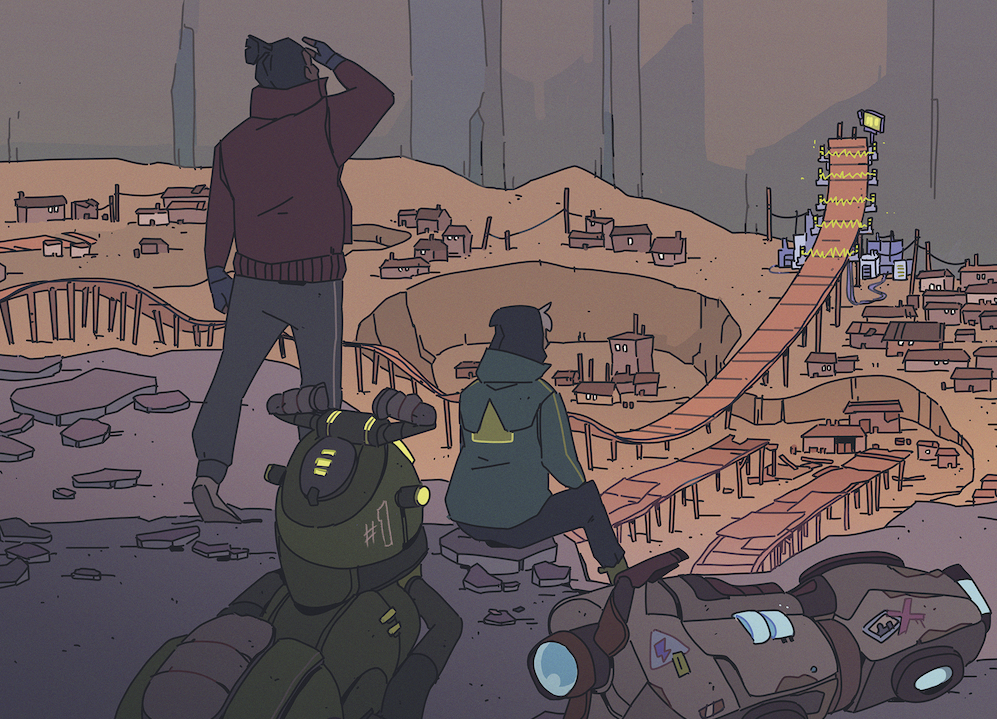
Last week I released Ridge City Riders, my new TTRPG about daring hoverbike riders who build custom bikes and rip through a junkheap city in order to generate power for their community.
To celebrate this release (okay fine, also to promote it), I’ve written a retrospective of sorts to discuss some of the design process and ideas that went into the finished product. Unlike my previous design commentary posts, I won't expect readers to follow along with the text itself; I’ll explain the game as I go.
If this post piques your interest in Ridge City Riders but you can’t afford to buy it, please don’t hesitate to pick up a Community Copy from the itch page linked above, or email me at paul@thoughtsabout.games and I’ll gladly send you a code!
Working with Collaborators
Before I talk about the game itself, I should note that this is the first TTRPG project that I’ve built with the help of collaborators. I’m very fortunate to have been able to do so without enduring the psychological torture of a crowdfunding campaign (much sympathy and respect to those who do rely on those methods). Throughout the process, Jess Levine (editor and sensitivity reader), Kim Hu (cover artist and logo designer), and Connie (interior artist) were wonderful sources of encouragement and creative inspiration. Beyond just contributing art and feedback, they also all challenged me to better understand the project I was building and to really make it cohesive.
If you like anything you see in Ridge City Riders, you should follow all the other excellent work these folks do—and take any chance you get to hire or collaborate with them, too.
The Setting
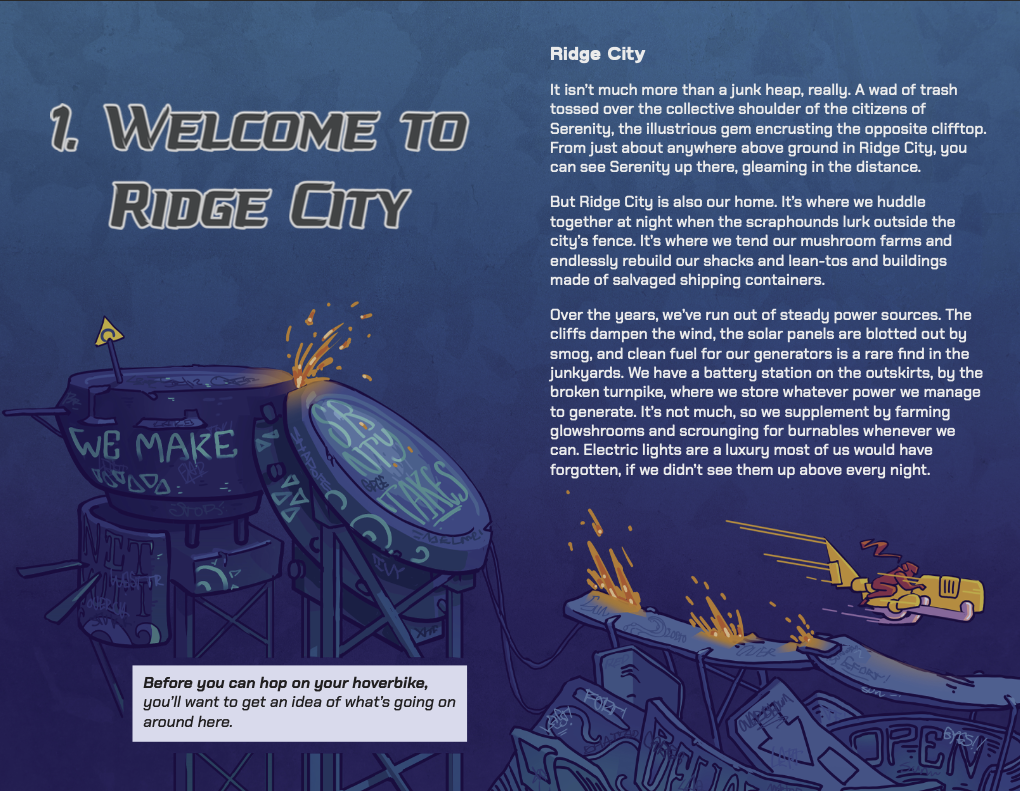
After some important preamble, the rulebook for this game starts with a description of its setting. Ridge City Riders takes place in a scrapheap city inspired by cartoon dystopias like Motorcity (the Disney XD show), the slums of Haven City in Jak II, the lower parts of Midgar in Final Fantasy VII, and the lower city of Zaun from Arcane. It’s falling apart, built on a massive junk heap, and starved of various crucial resources, especially electricity. Its world is a little cartoonish, but it’s also earnest and alive, filled with people who are doing what they can to keep each other safe and fed.
One thing you might realize about most of the touchstones I named is that they have one more thing in common: a shiny, prosperous counterpart, a city above. Ridge City rests on a cliff beside a yawning canyon, and on the other side (on a much higher cliff) is the city of Serenity. It’s a glittering megacity that most people in Ridge City have never been to and know very little about. But what they do know is that Serenity dumps all their garbage on Ridge City and sends well-equipped enforcers to keep them from doing anything about it.
Ridge City is all about instability: its built and rebuilt on top of layers of shifting junk, making it quite literally unstable, but its also a community that’s dealing with frequent resource scarcities, and it’s also a heavily policed population that’s getting sick of the abuse that they’re dealing with. Serenity, on the other hand, is distant and incomprehensible. It represents a kind of prosperity that’s hard to envision and held out of reach by the powerful. It’s presumed to be stable and secure, but who really knows? There is very little description in the game’s rulebook about what’s actually up there; the only way to find out would be to get there yourself, which is no easy feat.
But accessible or not, Serenity’s enigmatic tech still ultimately gets discarded into Ridge City’s junkyards. Thrill-seekers and gearheads cobble together these parts to build heavily-customized hoverbikes. But even hotshots like them have community ties that keep them grounded, keep them looking out for each other. They might have perfected their latest design, but they’ll probably need a little help from friends and rivals to really push it to its limit during its final dramatic run through the city. Hoverbikes are all about speed and daring, a way to escape the stifling presence of falling trash and patrolling cops. They’re recklessness, but also passion, determination, and the work of many hands.
Challenges
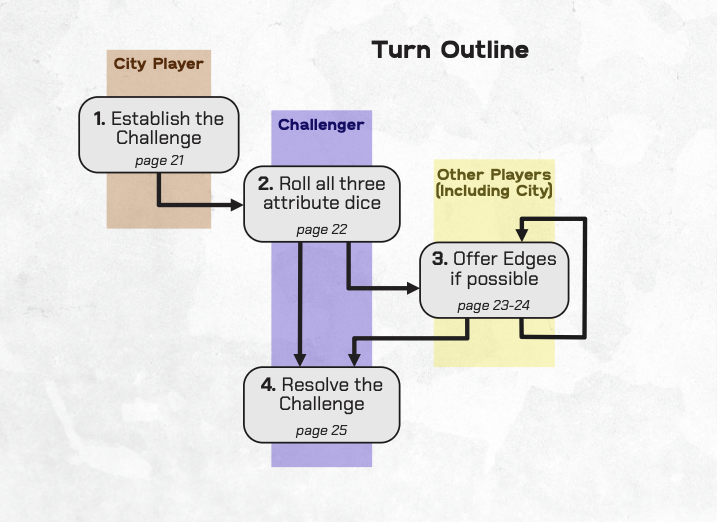
The game begins with players inventing their unique hoverbikes and sketching out the general idea of their characters. Then comes the core loop of the game: they take turns dealing with “Challenges” along their own separate routes through the city.
Each Challenge is an obstacle along the hoverbiker’s chosen route, something unplanned or unforeseen that’s making things complicated. During the Challenge, another player takes on the role of the “City Player”, narrating the obstacles that the Challenger faces. Each Challenge consists of several elements rolled by the City Player and narrated into a cohesive scene, but they also all come with Challenge Targets: a specific configuration of dice results that the Challenger will have to meet in order to succeed. Once the stage is set, the Challenger rolls their dice to see if they meet the requirements, and may potentially turn to other players for help. If those players are willing to spend “Spare Parts”, they can play out a flashback scene during which they give the Challenger some sort of “Edge”—maybe it’s an actual bike part, but it could also be a keepsake, a nugget of wisdom, or some valuable intel (Edges can be just about anything).
The Challenges are the core structure of play and the primary way that Ridge City gets described and filled with life, but the flashback scenes when players give each other an Edge are the thematic heart, bringing the characters into contact. Spending Spare Parts to give other players an Edge is a pretty straightforward helping mechanic, but there is also a limited pool of Spare Parts; they must be spent before they can come back to benefit their original owner.
The dice math for Challenges is not entirely straightforward, and since it’s a fairly unique system, it’s intended to be a little bit obscure, difficult to intuit or predict. Ultimately, I wrote a Python script to help me measure the likelihood of each kind of outcome and tune them accordingly. In the end, Challenge Targets are adjusted towards a very specific goal: low chance of success without help, high chance of success with help. Since help from other players is so valuable, there will be a wealth of opportunities to flash back, exchange parts, and flesh out characters and their relationships.
To top it all off, each Challenge has a special extra mechanic called a Complication; these add both flavor and subtle mechanical variation to each Challenge, which keeps things interesting and enhances the sense of unpredictability.
The Moment of Truth
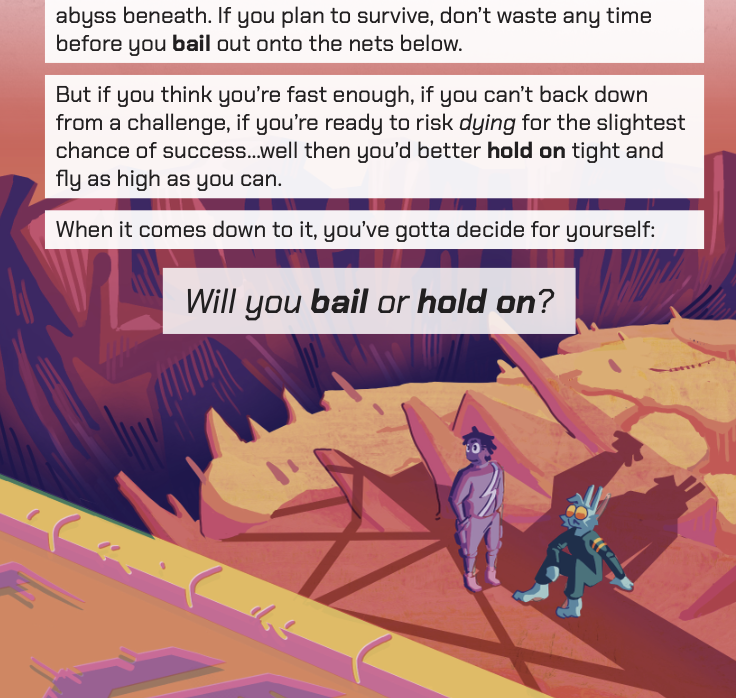
After each player has completed three challenges—or fewer, if running an abridged playthrough of the game—they bear down on Turnpike Rise, a broken chunk of freeway at the edge of the cliff that points directly up at Serenity. It’s rigged up with supercharger gates that generate power when the bike moves through them: the faster you hit it, the better. But the ramp is also the end of the run. Each player must decide whether they’ll bail off their bike at the last second, or risk everything to hold on and try to sail all the way up to the city above.
This is meant to be a big moment. Even in the very first prototype of the game, there were three possibilities for what could happen at Turnpike Rise. The first is that you bail out; you give up on glory in order to live another day, build another bike, and be there for your community. The second is that you hold on tight, nail a very difficult final challenge, and arrive in the mysterious megacity above, where you get to decide what happens next for your character.
The third possibility, and the most likely outcome for those who choose to hold on, is that you die. Some playtesters (as well as Jess, my editor) found this to be pretty shocking at first; they felt that it didn’t quite fit the tone of the game leading up to that point, and they were right. For me, it was core to the design; it would be a tragic moment that could be made affecting by giving players a chance to articulate what their character wants and why it might be worth the dire risk.
The Moment of Truth also has a cutoff for whether or not there’s even a chance to succeed. During the Challenges, each player tracks their Momentum, the total cumulative value of all their dice rolls; at the end, they subtract a bit based on their Loose Ends, their attachments to Ridge City that they earn by failing challenges or via certain complications, and then determine whether the total is sufficient. Most players will clear it, but some may have bad luck. The threshold exists to build anticipation, so that players are never quite sure what their chances will be to reach Serenity. But it also exists to subtly pressure players to try to hold on, no matter how foolish it seems. After all, why did they build up all that Momentum if they were going to bail out now?
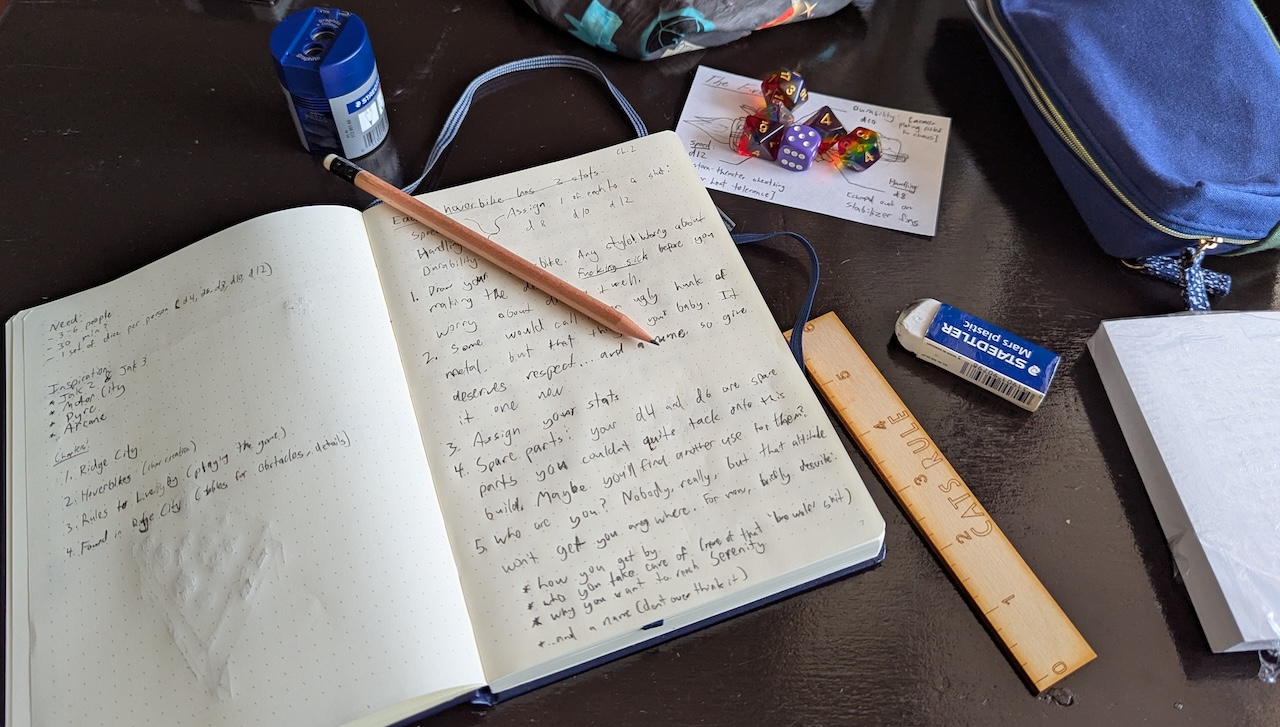
But regardless of the incentives and pressures exerted by the mechanics, it was clear that the earlier versions needed better telegraphing of the possibility of player character death. Ultimately, a key part of tying it all together was a plainly-stated explanation for why I wanted death to be on the table. On Jess’ recommendation, I stepped out of the game’s narratorial voice, just for a few paragraphs, to explain what I was going for: why it was important for death to be possible, why it was so difficult to succeed at the challenge, and how I wanted players to feel and think about the Moment of Truth decision. I think it’s exactly what the game needed, and it’s some of my favorite writing in the book. I like to believe that it reigns the tonal friction and brings out the poignancy of a choice like this, shaping it into a key thematic question for the game as a whole.
Wrap-up
Before I finish, I have one more fun fact: the initial idea for Ridge City Riders came from the prompt “Energy exchange”. It was provided by a friend who chose to host something like a game jam for his birthday party. He graciously judged the submissions, handing out charming 3D-printed trophies he’d designed to the winners of each category, and we generally had a lovely time sharing our creative work with each other. Both the energy generation element and the dice-exchanging mechanics spawned from that initial seed. Thank you for encouraging and celebrating your friends’ creativity, Zack!
It’s been a delight to work on Ridge City Riders intermittently for the last 14 months, and I’m so excited it’s out in the world. If anyone out there plays it, please let me know!