
This piece contains moderate spoilers for Cairn throughout, but there is a clear warning before discussions of the ending.
Cairn is the third major release from French game studio The Game Bakers, a team known for past titles like Furi and Haven. Though the genres vary, their signature style could best be described as expressive action and movement enfolded in focused, personal storytelling. Cairn, in turn, tells the story of Aava, a world-renowned mountain climber taking on her hardest climb yet and seeking a summit that none before her have reached. From its outset, Cairn seems to be putting forth a question: why do we climb mountains?
Initially, the appeal of Cairn for me was its clever balance of verisimilitude with legible game design. It uses a mechanical approach to climbing that relies on some degree of fidelity towards the realities of rock climbing, but it layers on fantastical technologies that smooth out the experience. Aava uses auto-drilling pitons and a science fiction wall-climbing robot (her “climbot”) that collects them for you, manages your rope, and holds some of your gear. Despite some of the marketing claims, Cairn doesn’t really feel like a simulation of rock climbing, but it is works admirably to represent the significance of differing holds, weight distribution, and movement on the wall. It’s a fairly successful gamification of what makes climbing fun to me: puzzling out the wall by plotting a route, executing, and adjusting to surprises and setbacks.
My climbing experience has been entirely at indoor gyms, but I enjoy it for the combination of physical and mental exercise. Climbing in Cairn can’t replicate the stakes and or the physical exertion of climbing in reality, but it does a compelling job capturing the problem-solving challenge. There will be setbacks, there will gruelingly difficult stretches, and there will be a wave of relief when you crest that next ridge. Climbing is naturally the thing you’ll spend most of the game doing, so it also becomes a pacing mechanism for the accompanying survival mechanics and narrative.
Kami, the fictionalized insurmountable peak where the game takes place, is full of little stories. The earliest sections have park notice boards with tips and warnings for climbers and hikers, as well as some derelict cable car infrastructure. Farther up we begin to find carved-out caves that were once inhabited by a mountain-dwelling folk, now nothing more than empty refuges for passing climbers. There are notes written in a native language (that Aava can seemingly read somehow) that gesture at the culture of these folk, the significance of various locations on the mountain, and the vague forces of modernity that drove them to abandon their homes and join the world below. And eventually, as you keep climbing, there are bodies. Climbers whose lives were claimed by their relentless pursuit of the summit, whose bones and backpacks are now subsumed into the jagged texture of the mountain’s face.
But despite all this effort to make the mountain seem enormous and full of history, the climb itself is a fantasy. It neatly sidesteps the ethics and logistics of mountain climbing; Aava casually drills pitons into the rock wherever she likes (a destructive approach that’s typically avoided by modern climbers), and the science fiction contrivances let her effortlessly cover her tracks and open the path ahead of her. Bear boxes contain fresh supplies, stocked by who-knows-who. Aava can pick up litter on the mountain and have her climbot compost it into extra chalk to improve her grip. The paintings and notes left behind by the absent mountain-dwelling community are there to bring an air of spiritual significance to the mountain, to highlight the hubris of past mountaineers, and to convey hard-won route knowledge to the player; they never feel like a people whose own story matters, and they’re all gone by the time Aava is there picking through their dwellings and sacred sites.
So it turns out, then, that Cairn is actually about the mythic notion of climbing a mountain more than the reality. There is no expedition. No climbing partners. No sherpas, no native inhabitants, no crowding. The other people Aava meets on her journey are singular individuals with pursuits of their own, presenting various foils for her to bounce off of. Marco, the younger climber who looks up to Aava and gets to know her when their paths occasionally cross, is mostly pushed aside to forge his own route. Nobody exists in community, no one must make any effort to be a steward or a caretaker. Everyone on the mountain is a lone agent of ambition, hubris, or level-headedness. Only the notes on corpses seem to talk about other people.

In carving away these realities, Cairn sort of becomes its own abstraction. Its difficulty as a video game becomes the metaphorical thing that must be overcome. Why, it asks, do we (desire to) climb (metaphorical) mountains? Just like Aava’s laser focus, Cairn pointedly erodes the context of the world around its protagonist in order to build a heightened and distilled man-versus-nature struggle. The world below is infinitely far away, remembered only when it frustratingly intrudes upon Aava’s singular pursuit. The way Aava sees it, it’s only her and the mountain, and the game itself mostly makes that true.
It’s very reasonable to be frustrated by everything that Cairn pushes to the side, and these convenient omissions deserve to be interrogated (go read Jay Castello’s thoughtfully critical piece at Unwinnable). But as I saw the facade of “realistic” mountaineering falter and fall away, I found something compelling about the starkness of the questions it asks, and especially how it frames them through its characters. Aava’s moments of frustration and loss, both in her own setbacks and in the faraway trials of daily life that she’s missing out on, are still resonant. Her all-consuming desire to push past her limits, in spite of what it does to her and what she seems to be avoiding, is recognizable and empathetic—even though it’s also nakedly destructive and unhealthy. Aava struggles to find meaning in other people and in the world outside herself. It’s tragic and infuriating, and it’s inextricable from the question of why she’s doing all this.
Late in the game, Aava is met with resistance from Marco and another character on the mountain who have assessed the danger ahead and decided that continuing the climb is not worth the risk. She sleeps on it and soon afterwards she reconvenes with Marco as he begins his own descent. At this point, the game presents a choice: end your climb here and go back down with him, or return to the mountain and seek the summit against all odds. It’s the first direct narrative choice, breaking the fourth wall to offer players an early-out. There are numerous moments leading up to it that suggest that Aava is too deep in her own head, that she needs to reassess her priorities, make the healthy choice, and come home to her loved ones.
But the Aava we’ve met and played as this whole time isn’t that person. Her frustrations and pain have not drawn her closer to anyone, but intensified her emotional self-isolation. She’s withdrawn into an uncompromising individualism, a complete refusal to accept either failure or help. She isn’t ready to come this far only to turn back. Despite the risk, despite the costs, she wants to reach the end. The game puts forth a challenge directly to the player that aligns with the question Aava herself faces: are you really going to give up here? After coming all this way?
To me, this question is drawing on the competitive and completionist mindset in the modern internet landscape of video games. It’s a veiled jab at the 100% completion chasers, the achievement hunters, the challenge runners, and even the casual players who just want to see credits roll before they put the thing down. Cairn knows you want to see the end, you want to see everything that’s in the game, and that you’ve probably been socially conditioned to stubbornly pursue it. Like Aava, you don’t want the easy way out; you want the full experience. So, if you’re like me, you choose to press on.
⚠️ Warning: Full ending spoilers ahead, as well as some mentions of pet death. ⚠️

Beyond this point, the climb becomes more challenging. Resources dwindle more rapidly and the mountain asserts its the true brutality. This final stretch presents some of the most difficult sections so far, and soon things become fuzzier and more surreal. At one point, Aava loses consciousness and wakes up in her tent, unsure whether she dragged herself to it in a haze or was pulled in by her robot companion. She begins to hallucinate and her vision swims, and the climb becomes more treacherous yet. Eventually, some of the survival mechanics drop away just to let the player proceed to the ending of Aava’s story, but it feels like there’s always a little more mountain left than you thought.
And then, after a final focused stretch, Aava staggers up to the pinnacle, collapses to her knees in the snow, and screams into the whipping wind, a guttural shout that both proclaims her triumph and laments its steep price. Her partner waits at home, having recently said goodbye to their beloved cat who fell suddenly ill, a trauma that Aava wasn’t there for. By this point, the climbot that Aava has relied upon for years has unambiguously become a proxy for her lost pet. As you near the summit, it sputters and gives out. By the end, it’s either plunged into the snow hundreds of feet below, or clutched cold and lifeless in Aava’s arms, depending on whether the player chose to cut it away when it went dark or pull it along with her.
As she sits there at the top, all her energy spent, a prompt appears on the screen: “Be part of a whole”. We press and hold the button for a moment. Then Aava looks up, sees the stars above her, reaches out…and grabs one. She places one foot on another star. Then, controlling her again, we climb. Aava pulls herself from star to star, into the sky, reaching higher, further, each one etching out a constellation as she touches it, now launching herself with each pull, faster and faster, until she becomes a streak of light, a shooting star. She becomes part of the mountain, part of the sky, part of the universe. This is her death; alone at the top with broken equipment and the whole world endlessly far below her, she finally gives herself up to something bigger than her.
To “be part of a whole” is the most specific interpretation set forth so far for the enigmatic feeling that Aava has been chasing. This is how Cairn expresses the culmination of her desire to achieve something no one else ever has and transcend her own limits, to defeat the unnamed demons inside her. It seems at first like Cairn is offering an answer to its central question, but it immediately feels incomplete and insufficient. As Aava’s star streaks away, the ending title card appears and we see the little constellation of stars etched between the letters animate into place, taking on a new meaning.
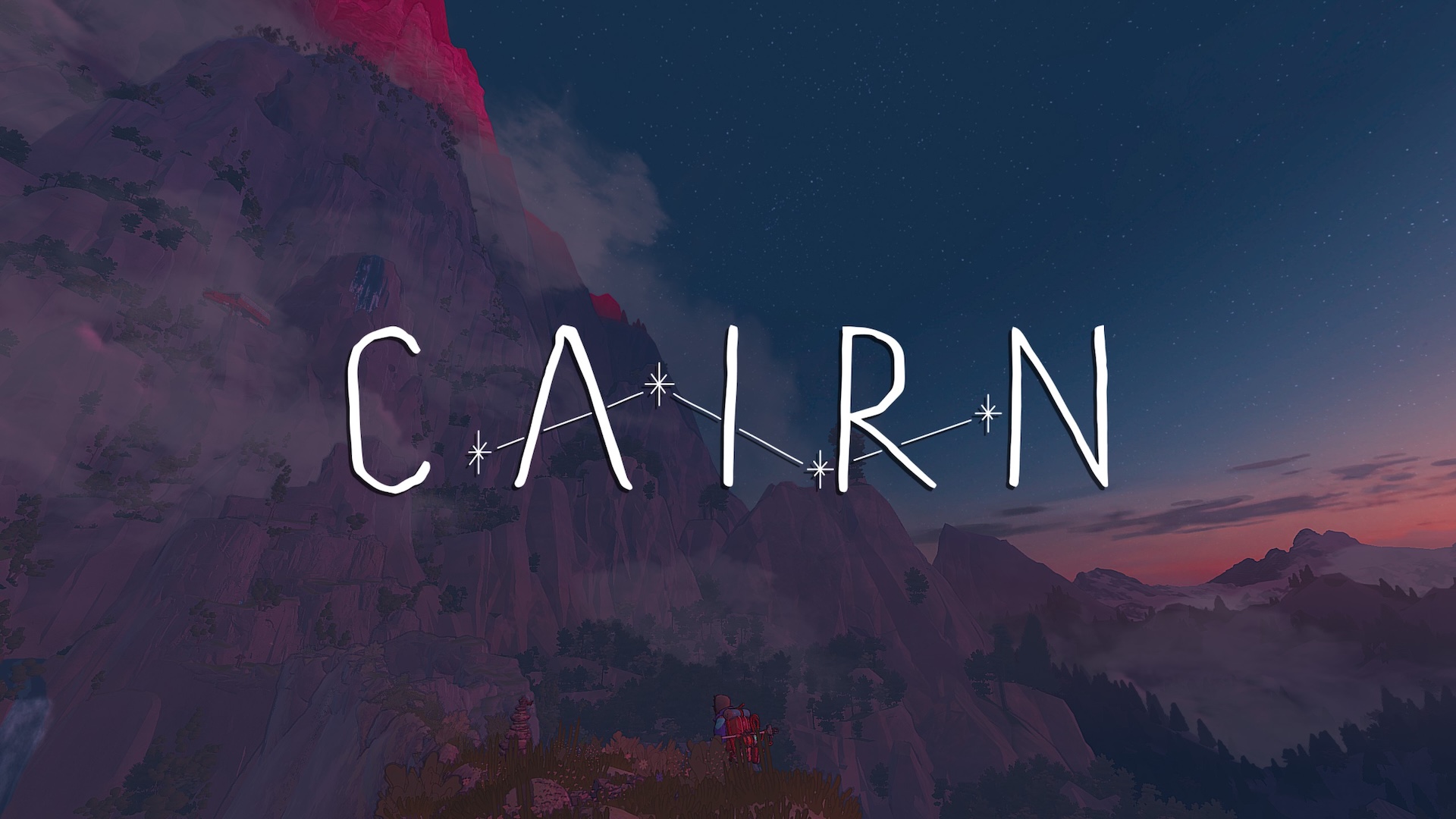
I’m fascinated by this final imagery of constellations. The stars in the sky are lightyears apart, proximate only in the context of our earthly perspective. There are no lines connecting them together. Constellations are made by people. Constellations are connections between individual stars that people create, that people imbue with significance. To me, a constellation represents the ties between human beings. It represents looking up at the stars and imagining that surely they can’t each be so singular and lonesome, surely they must connect to each other and be part of a whole together. Constellations represent the greater whole that Aava refused, the network bonds between individual people and pets in her life that she could have returned to if she chose.
At the end of the day, I like the contradictory metaphor. Climbing into the stars while the music swells, I certainly felt something momentous, but it was hard to actually identify it. Aava either stubbornly rejected all the things that make her human, that connected her to other people and to the world…or she recklessly pursued the only thing in the universe that matters at all. We can’t really know which one is the truth for her. The answers don’t satisfy. The question lingers.