Update 12/22/25: When I initially wrote about this game, I had forgotten that developer MachineGames was under the publishing umbrella of Microsoft, a company that is currently a priority target of the BDS movement due to its direct complicity in Israel's genocide in Gaza. I'm leaving this blog post up for posterity, but I'm encouraging readers to follow the guidelines outlined at No Games for Genocide by activists within the video game industry. I've personally pledged my support to this effort and will make a point to avoid covering games published by Microsoft until it ends this complicity.
In my sprint to play a few more of 2025’s games—and lend some legitimacy to my impending top 10 list for the year—I’ve gone all the way back to last December, which I’ve decided to count as within my “2025 release” cutoff. That meant circling back (please clap) for Indiana Jones and the Great Circle, a title I was interested in but never quite made time for over the past 12 months. I’ve not yet finished the game, but I’ve already got a lot of thoughts about the way it finds its niche as a stealth-focused adventure.
Crucial to effective stealth gameplay is enemies that are daunting and dangerous. Giving those enemies plenty of firepower is a classic, straightforward way to make them credible threats, which is why a good number of the various sorts of fascists who wander the regions of Great Circle are packing some sort of heat. That may not seem remarkable in a stealth action game, but it’s a big part of what you can and can’t get away with while you explore the levels. Rifles and revolvers are around, and Indy often has ready access to a revolver like the one he’s often seen with in the movies. It’s easy to miss this, though, and it very well may be the case that you interact with firearms for the first time only after you start knocking out the Italian fascists who carry them and picking them up.
When I first did this, I was already several hours into the game. And I when I aimed and fired it, I was a little surprised that I was even allowed to do so; thus far, the game had been perfectly content to provide me with shovels, wrenches, and the like so that I could quietly bonk my enemies over the head. There was even a boss fight that was entirely a hand-to-hand encounter.
But when I tested out this gun I’d picked up, I immediately remembered that developer MachineGames knows what they’re doing with this sort of thing. Perhaps a true FPS enthusiast could provide a more authoritative assessment, but in my opinion, that automatic rifle I picked up had all the heft and impact you’d expect from a well-made FPS weapon. The “gun feel” was, to be honest, pretty good. It didn’t feel awkward and ancillary the way that Corvo’s pistol in Dishonored does, where ranged weaponry feels very separate from (and secondary to) the core verbs like blinking around and performing sneak attacks.
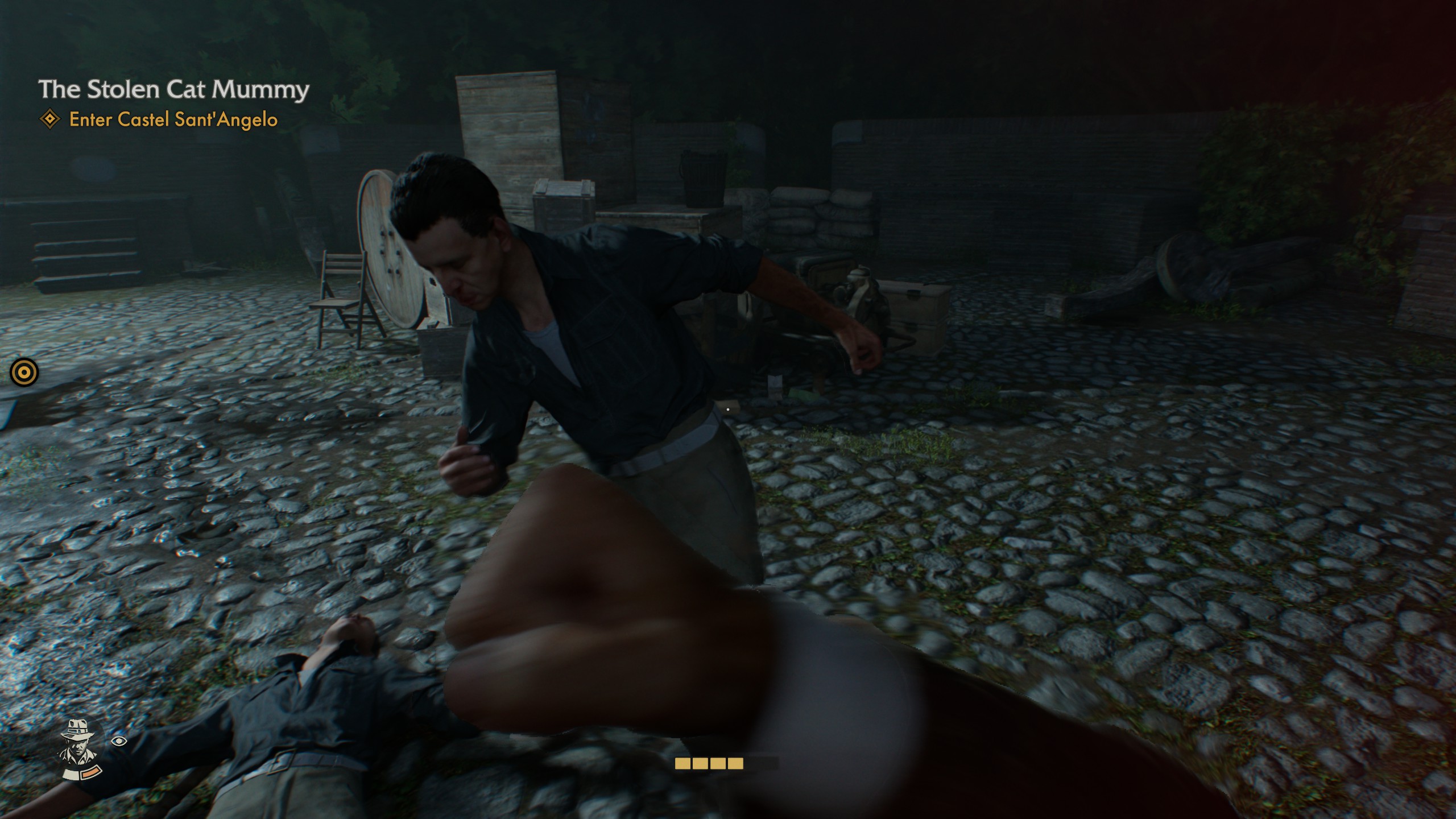
No, in Great Circle, the guns seem like they’re meant to feel powerful, dangerous, and—well, like they would in a more typical shooter. They’re so effective at defeating Indy, in fact, that In most scenarios enemies won’t even draw them until he fires the first shot, instead preferring to attack with nightsticks or bare fists.
But that’s not the most interesting part about it. What’s interesting about the guns is that they’re really not that useful. Throughout the game, Indy must cautiously pick his way through fascist-occupied buildings and nazi camps at archeological digs. Success comes down to minimizing the scale of the conflicts you get into; cartoonish sneak attacks and frantic, muffled brawls are the only way to avoid alerting dozens of enemies to your infiltration. At the highest difficulty, the crack of a gunshot most often signals an impending game over and checkpoint reload.
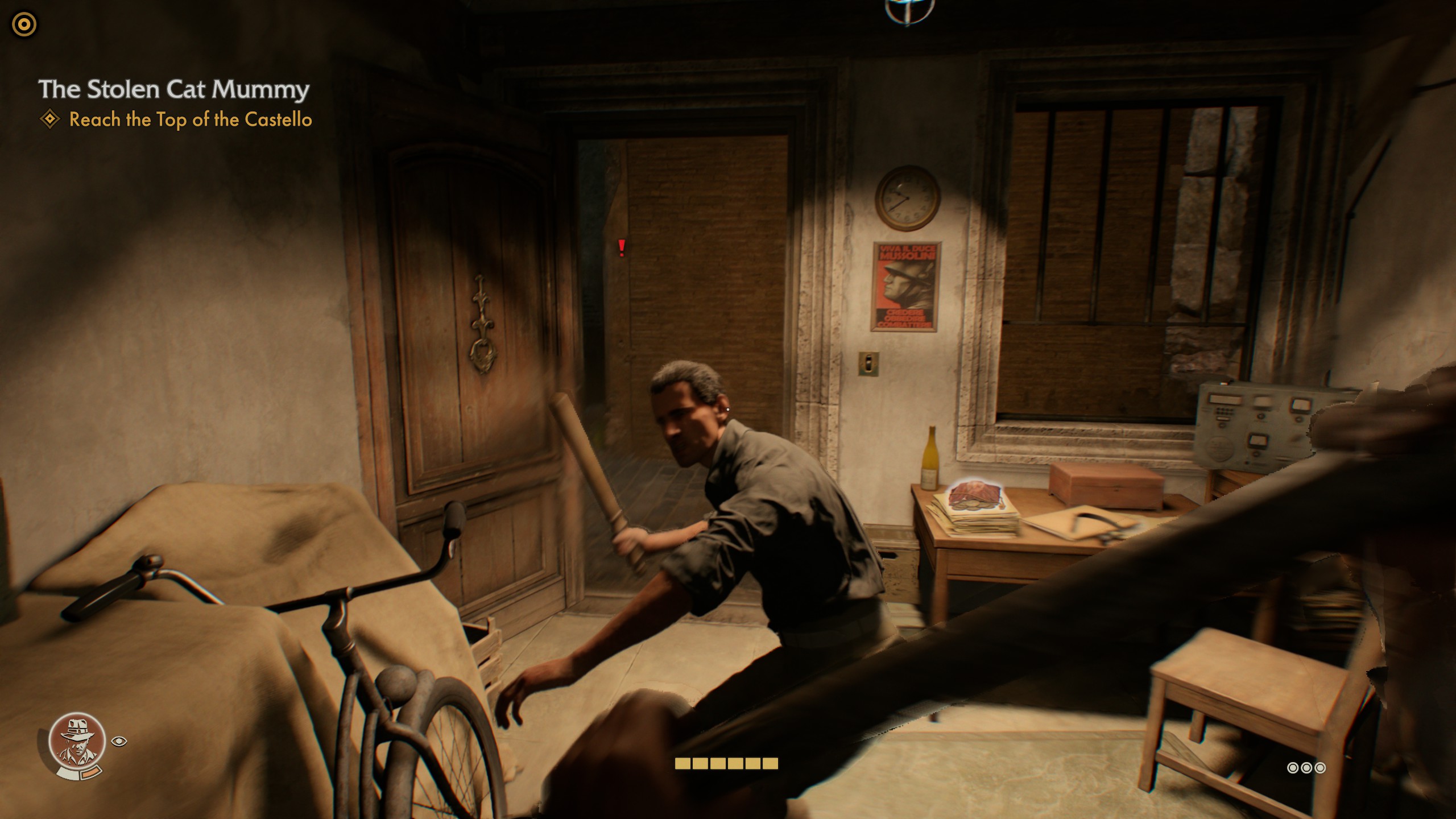
Indy’s signature whip and the dukes he puts up when he enters melee combat are far and away his most stalwart tools, and the combat design around fistfights and melee is clearly an area of greater focus than that of gunfights. The guns, it would seem, are only as tightly designed as they are because of the carried-over talents (and perhaps even technology) of MachineGames in the wake of their Wolfenstein reboot series.
I’ve been finding a lot of enjoyment in the way that Great Circle adapts a campy movie series to its gameplay. Stealth takedowns are only possible if you pick up various items from around the level, most of which quickly break and must be replaced, which plays up Indy’s resourcefulness and puts a lot of silly everyday objects in his hands to be swung at his foes. Just like an action adventure movie, the game never sweats just how lethal these bonks on the head or pushes from a scaffold might be. It’s less about deciding whether you’ll kill or K.O. someone, and more about enjoying the comical slapstick and environmental hazards when you sneak up and trigger your sneak attack animation. When holding a gun, Indy can press a button to flip it around and grip it by the barrel, turning it instead into a breakable melee weapon that’s perfect for bloodlessly clobbering your unsuspecting foes; one more bit of player-driven tone setting that feels right at home for the character.
Mechanically, it all functions a lot like Dishonored, but tonally, it feels a lot more like modern Hitman, delighting in violence that’s both silly and justifiable. If Wolfenstein seems to say “isn’t it rad to mow down a bunch of nazis?”, Indiana Jones is saying “isn’t it hilarious to tap a nazi on the shoulder and then cracking a broom across his face when he turns around?”
My thoughts about the legacy of Indiana Jones as a character and franchise are a lot more scattered. I’ve never had any nostalgic fondness for it, so I can say with clear eyes that the genre of intrepid treasure hunters going on wild globe-trotting adventures brings with it a lot of troubling fixations and tropes. Even with Great Circle’s self-aware pulpiness, modernized interpretation of Indy, and genuine interest in history…the undertone of cultural tourism is impossible to shrug off, and probably inextricable from the core conceit of the character. Despite all that, to those for whom there is still fun to be found in pulpy adventure stories like this, Great Circle has managed to translate it well by making smart, restrained choices about how the hero navigates the trials in front of him.