
In recent years, I’ve found myself increasingly drawn towards difficult games. I don’t always stick to them, and often I find that particular frictions overcome my interest more easily than others. Occasionally, I encounter something that I find to be crushingly difficult, but too rewarding to put down despite it. Games like Lies of P and Hollow Knight: Silksong fall into this category—brutal, punishing, but immensely satisfying despite it all. The level of challenge they present, and the parameters and expectations they place around it, are legible enough to me that I can find fault or shortcoming in myself pretty naturally when I fail, and that I can channel my negative feelings into focus and perseverance.
A recent polarizingly-difficult game that I’ve dug my heels into is Mina the Hollower, Yacht Club Games’ long-awaited new title after more than a decade of Shovel Knight spin-offs. It draws from a few different classic console influences, but It’s closest cousin is a 2D Legend of Zelda game. It revolves around an overhead view, a big world of sectioned-off spaces to explore, and a gradually expanding set of mechanical options to aid in exploration. More so than most of its peers, Mina does not rely on an arsenal of unique tools or abilities to help her get around; instead, most new areas teach players a subtle-yet-crucial new detail about Mina’s basic movement (running, jumping, burrowing into the ground, and popping back out) that can be used in a novel way.
Exploring each screen in search of well-hidden secrets is delightful, some of the most fun I’ve had with a game’s world design in a long while. The de-emphasis of special abilities to acquire means that anywhere you look, you may be able to find your way to where you want to go without needing to come back later wielding some new tool. The world feels big, intricate, and dense with details to miss unless you scour carefully and cleverly. The hidden things to be discovered within it are often substantial, exciting, or intriguing.
But much like Shovel Knight, Mina the Hollower is also a deliberately difficult game, demanding constantly careful maneuvering and rarely allowing a lot of mistakes. For players who choose not to adjust the overwhelming menu of difficulty modifiers, it initially seems to present a level of challenge comparable to its contemporary “difficult games.” But playing it has made me more intensely frustrated than I typically get with difficult action games, and I’ve had to look a little more closely to understand what it’s asking—and why I haven’t been listening.

For a good while, and to some degree even now, the way that Mina the Hollower approaches difficulty has irritated me. Difficulty often comes by way of a quantity of chaos on screen: aggressive enemies that leave few openings, delicate dances of platforming while under fire, and never-quite-clear notions of enemy positioning and hitboxes. Mina has very brief invincibility after being hit, and she often resets to the beginning of a whole screen when falling into a hole. Layering onto that, it provides five main weapons for Mina to use, all of which work a little differently. Some of these weapons are interesting and tricky, but they wind up being extraordinarily hard to use against many of the most basic enemies that Mina encounters early in (and throughout) the adventure. And that’s to say nothing of the boss fights.
It’s interesting finding myself on the “hater” side of a question of game difficulty, especially for a game that otherwise has so much about it that I love. To my sensibilities, the bosses in Mina the Hollower (not to mention a number of regular enemies) do not feel good to fight. Many of them dash or swoop around in strange ways, floating at indiscernible heights and flailing towards the player with an inscrutable hitbox. I gravitated for a long while towards the quirkier weapons because I found them far more interesting to use, but enemy behaviors will constantly confound my attempts to use them effectively. In that regard, I can’t ignore how much my own stubbornness is part of the equation. I was approaching boss fights as being solvable with any weapon I choose via mastery and timing; and no doubt they are, but the gulf in difficulty between options is far more substantial than I initially thought. And I found that I needed to shift my thinking and regard them as exercises in planning rather than execution.
The bewildering first impression set by the opening moments, during which the player is locked into the initial weapon choice they make, is indicative of this problem. Choosing the mace or the daggers gives Mina a simple, directional attack with a bit of reach. But the hammer gives her a tiny and pathetic swipe as her basic attack and a big overhead swing that takes a surprising amount of time to charge, which can be interrupted.
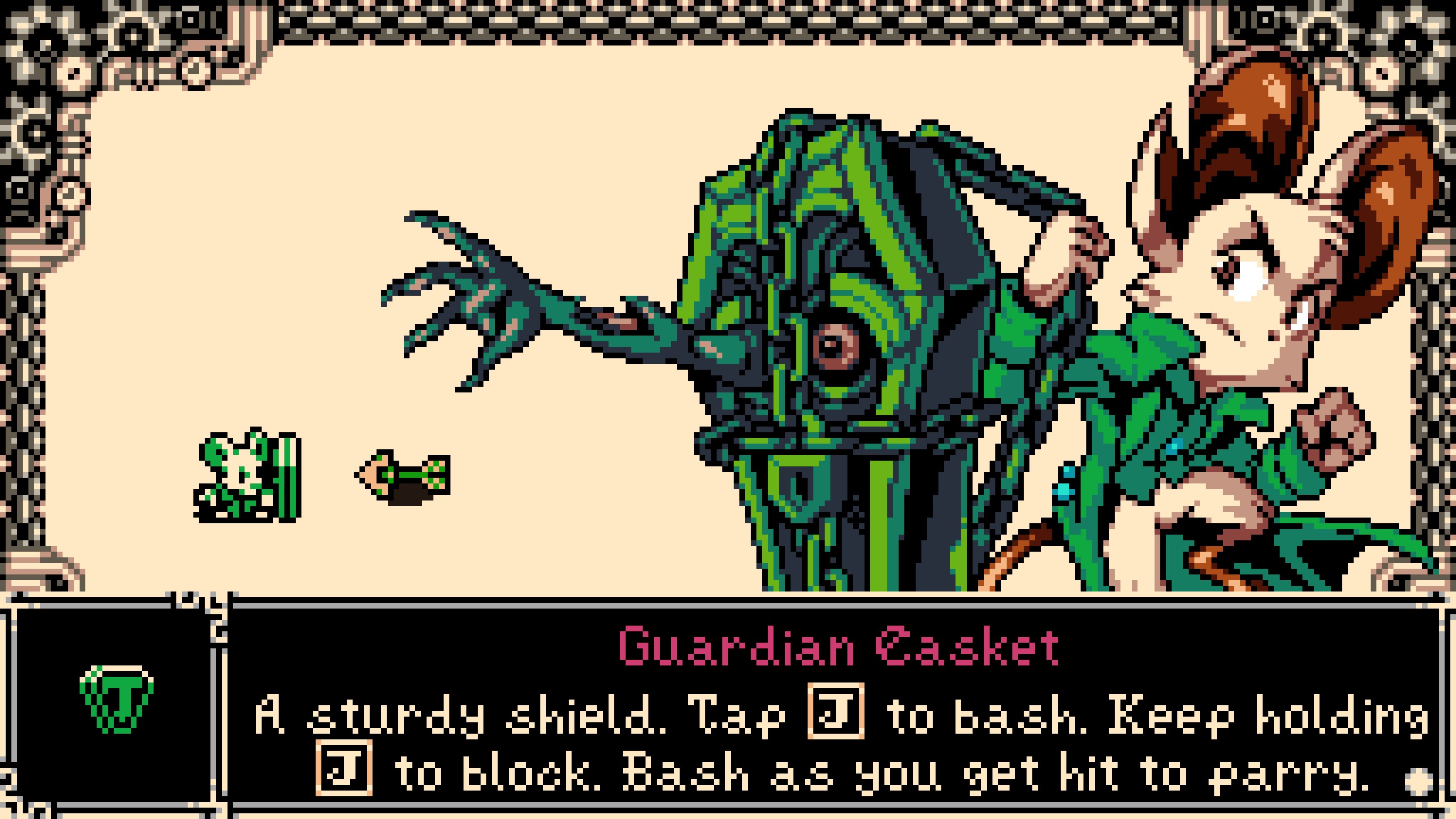
When I play video games, I’m an experimenter. I beat at least one boss in Silksong with each of the different crests. I’m a keep-the-whole-JRPG-party-evenly-leveled kind of guy. When I see a variety of options, I want to spend a little bit of time with each of them and get to know them. There are a great many games in the long shadow of Dark Souls that make weapon choice an expression of preference and playstyle but Mina the Hollower is doing a subtly different thing: each weapon is one of several options to put in an ever-growing tool belt, which also includes sub-weapons and equippable trinkets. It’s not a game about locking in and getting good, not really. It’s a game about exploring more, buying a couple more upgrades, rearranging your loadout, and trying a different approach. The five core weapons are by no means equally suited to each boss fight, and in many cases one or more of them feels wildly inadequate despite managing just fine against the enemies leading up to the boss.
In this regard, I’ve had to more consciously resist the psychological manipulation of the “corpse run” mechanic that’s been so resoundingly popularized by Dark Souls. Each attempt to recover my resources might be met with new frustrations, and enemies who defeat you must be defeated in turn to reclaim Mina’s “spark” and retain her collected resources. The subtle differences in how it works are substantial: losing the spark does not leave your resources behind, but dying without recovering it does. Sometimes a tactical retreat to go purchase an upgrade is the right call, even if the the player is urged forward by the sheer inconvenience of returning to town, because the resources aren’t actually lost yet. Mina can eventually get multiple sparks, after which she only loses everything when all of them are lost.
In other words, as I’ve gotten frustrated with the failures of my reflexes and intuition, I’ve stepped back from the execution aspect and tried to pay more attention. I’ve started to immediately put away the big hammer or the parrying shield whenever I reach a boss fight, and I’m finally ridding myself of the expectation that “they put these weapons in the game, they should have all be viable options.” I’m trying to direct the recurring moments of frustration towards observation and experimentation rather than tedium or anger. I still have some big problems with how it feels to move and fight enemies in this game, but in the end, it might be that I’m just not very good at executing on its core combat skills. In that regard, it’s nice to see that my way through is being supported by its breadth of equippable items and my intrinsic motivation to seek them out.
So far, I’m still too stubborn to fuss with the modifiers, though when I scrolled through them, I found few that would alleviate my particular complaints, despite the huge variety. But, if it comes to it…well, I’ll at least think about it.