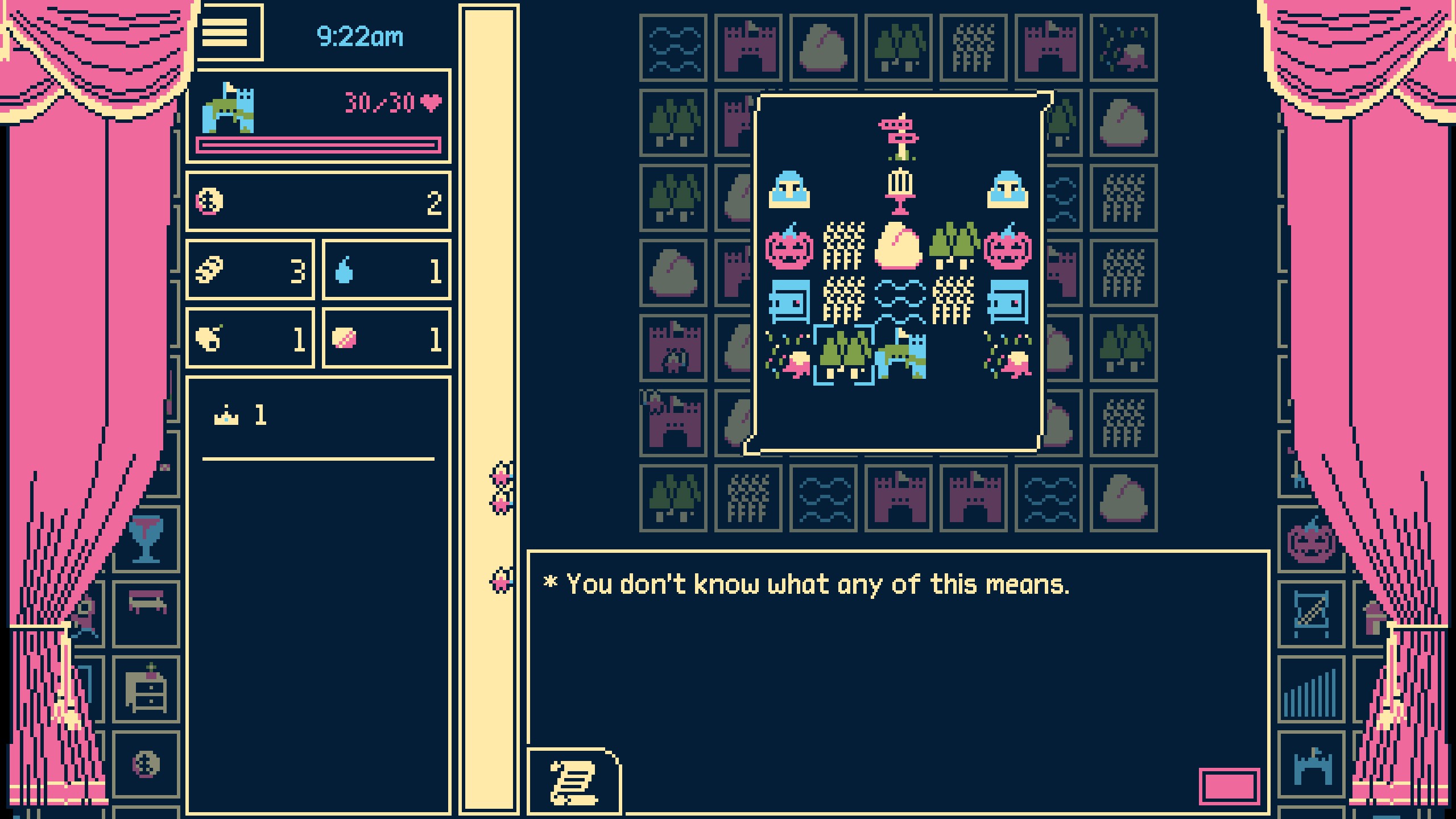
Over the past weekend, I found myself becoming deeply fascinated by Titanium Court, a newly released title from designer AP Thompson that’s been enjoying a hushed buzz from Independent Games Festival judges who saw it ahead of its launch. Titanium Court pitches itself as “a surreal strategy game for clowns and criminals”; this is a way of telling players whether or not it might appeal to them (do you enjoy the micropoetry of this phrase? do you find it funny or intriguing?) while also literally identifying who it’s for (are you a clown? a criminal, perhaps?).
In many ways, this layering maneuver captures far more of Titanium Court’s identity than I initially realized. At it’s core, Titanium Court is a roguelite mashup of a match-3 puzzle game with a tower defense strategy game. But as I’ve said, that’s only its core. Many of its peers in the genre create variety and depth by enfolding their core loop in incremental systems: gradually widening pools of items or cards, small improvements to starting resources and options, or unlockable variant characters that approach the core gameplay in different ways. But while Titanium Court has all of these things, what makes it feel unique and fresh in the roguelike space is that its metagame, the game of interacting with systems that operate outside of and across runs, actually feels like a game itself.
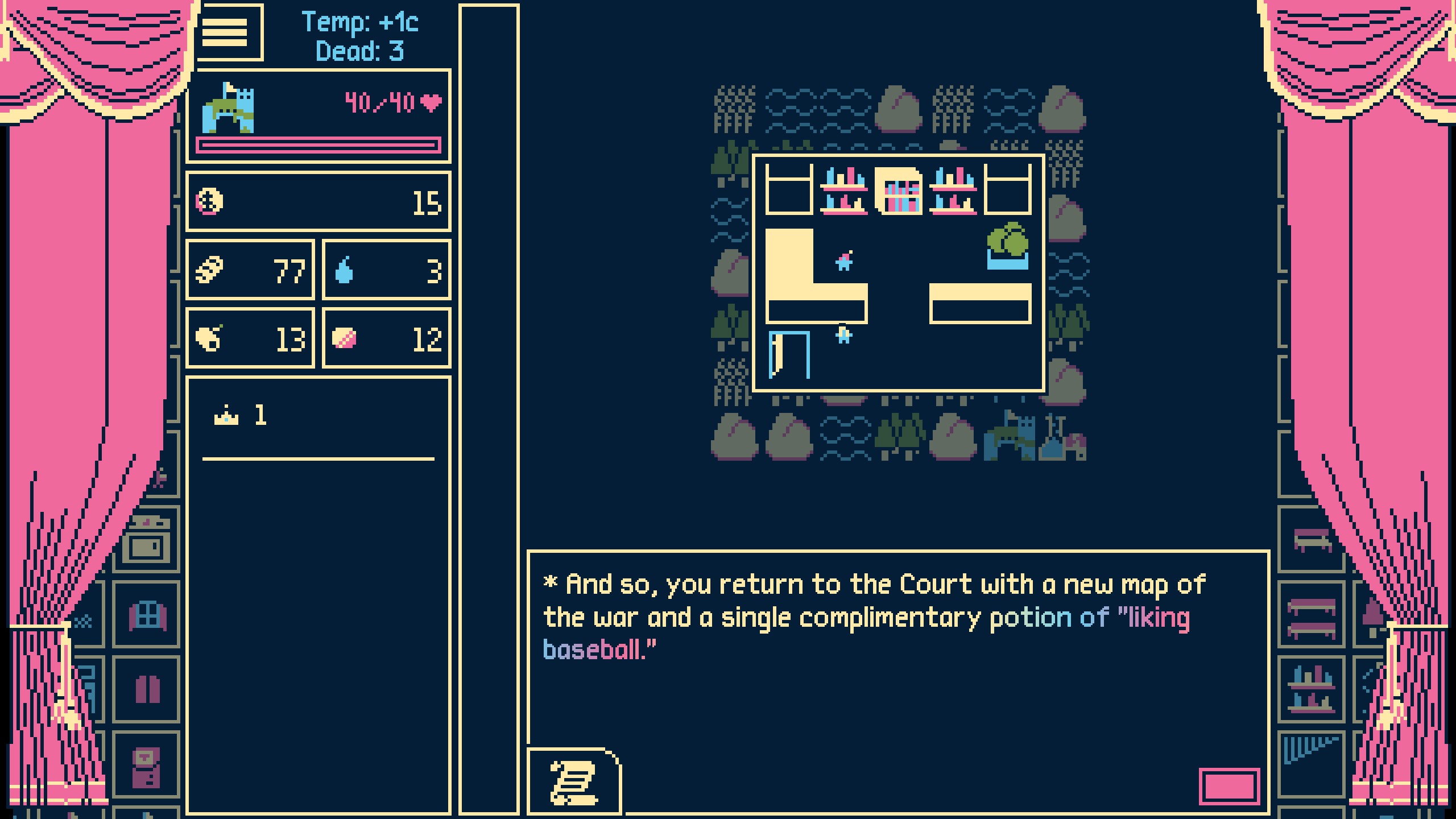
I’ve put a little more than 8 hours into Titanium Court, had my share of defeats and a few victories, and never really quite had the same run twice. It treats meta-progression (the additive systems that operate outside of individual runs) as something playful, surprising, and narratively expansive—game mechanics and story beats in their own right. For Titanium Court, it would be insufficient to provide a big upgrade tree or a home base full of characters with little subsystems to manage. Instead, it bookends each run (an attempt to wage war with the nebulous hordes surrounding the Court) with an exploration sequence around the grounds that unfolds like an adventure game. Each visit reveals strange new scenes and clues and avenues for discovering new gameplay elements. While I do now have a solid idea of how the game functions, the full extent of what it has in store is still unclear to me, and there’s no way I’ve seen all of its surprises. Since everything I’ve encountered so far has been deftly folded into the strange fey logic of the world in which it occurs, there’s a great deal of possibility that it could bring to bear without feeling inconsistent or unfair.
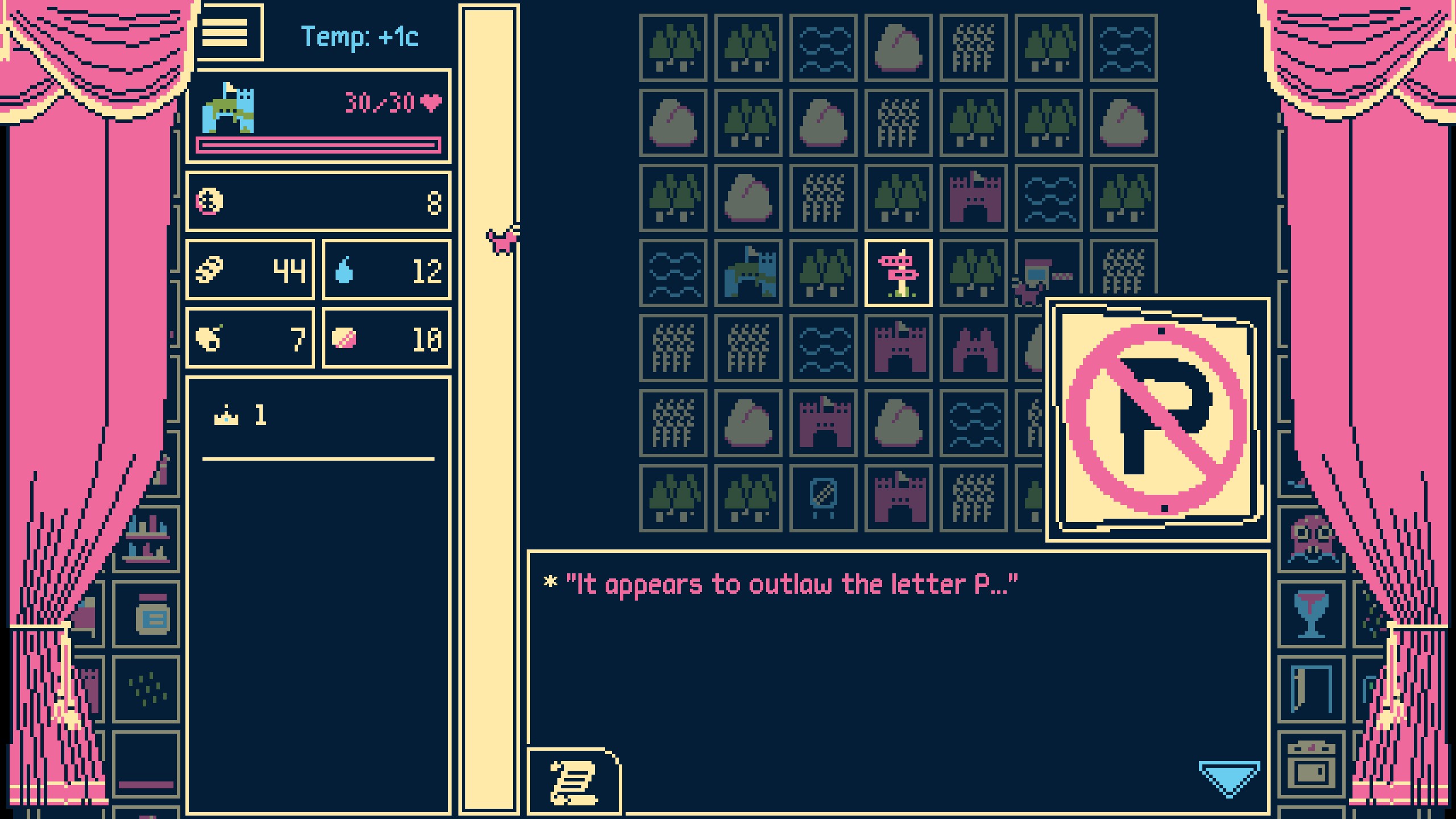
Core to the fun and the humor of the game are the metaphysical mysteries of the Court itself: why are you here? Why have you been crowned as its monarch? Why do these people regard completely mundane things as magic, but take inexplicable phenomena completely for granted? How does this bizarre world of shifting tiles really work, and what is the mysterious Tide that pulls the court ever forward? Why, exactly, are you waking up and going to war every day? Since when is “Youth” a job? While it’s easy to roll with the punches and take it all in as game logic (or fey logic; either one works), the second-person narration of the game frequently puts thoughts and ideas into “your” mouth, has “you” explaining basic mortal concepts to your oddball courtiers, and seems to ultimately hope to coerce “you” into investigating the mysteries about the Court itself. These questions, in fact, wind up being intertwined with another meta-progression system, a clever hybrid between an incremental storytelling mechanism and a hint system that illuminates new avenues of investigation.
The engine by which all of these ideas unfold is the game’s truly delightful writing. Whether making effortless off-handed jokes or waxing poetic for an elaborate bit, the writing is consistently funny and often more committed to its own bizarre logic than you might expect. Little details regularly spring back up in surprising ways, and seemingly-throwaway jokes unravel into whole subsystems or charming recurring bits. One common tactic of Titanium Court’s narration is a disorienting disrespect for the solidity of the fourth wall. The second-person narration’s pointed blurring of the line between player and protagonist, between willing player-participant and isekai’d fey queen, is only the first of many metanarrative maneuvers. When the explanatory capabilities of the fey courtiers falls short, a tooltip with its own distinct character voice steps in to clarify the purposes of certain screen elements. The tooltip seems to be aware of both the elements on the screen and the conversations occurring between the characters. Is it explaining this to you, the player, or you the protagonist? Does this distinction even matter? Later on, the normal narratorial voice cheekily accuses its player of destroying the game by “consuming” it, by reading and exploring it until there are no new things to find. When you fully unlock the difficulty adjustment system, two characters have a philosophical debate with you about the merits of overcoming challenges versus the pleasure of easy victory. Hell, in the opening sequence, a character very nearly states the title of the game, but conspicuously veers away for it to be later lampshaded during the title card; even though the game knows you know the its name! You’re playing it, aren’t you?
All of these shenanigans are accompanied by a bright color scheme and pixel art that always seems more expressive than should be possible with its limited palette and scale. Leaning on minimalism, it admirably balances clarity with abstraction—and there’s no shortage of abstraction. To make things even sillier, I can’t help but point out how the game uses visual metaphors: during the tower defense portion of the game, where pre-planned actions occur in sequence while the player watches the battle unfold, key moments are punctuated by screen effects and pixel-art panels that pop over the battlefield, depicting unrelated-but-resonant activities that usually involve some sort of play or performance. Destroying an enemy stronghold might be accompanied by an image of a Jenga tower mid-tumble; a catapult slinging a rock at your base might be dramatized by a flip book sequence of a tennis serve. Victories are met with scattered panels of brass players or leaping dancers arcing across the screen. At every turn, you get the sense that these fey folk aren’t really taking this whole thing all that seriously (and indeed, they are not).
I don’t think I have the chops to properly inject Titanium Court’s flair for surrealism into my video game criticism, but I don’t think the central stunt of this post would be complete without a little bit of meta-reflection. One of the things I love most about video games is how well they can bury and slowly unearth their central conceit, how much they can change and shift as you progress. They can twist themselves into whole other genres, whole other experiences, and they can give you pause to reflect on that shift. They can invite you to examine the layers of connective tissue that surround the narrative or mechanical sequences. They can inspire someone (only hypothetically, of course) to get up to some real clown shit on their blog, and to repeatedly commit the (dubious) rhetorical crime of using second person pronouns in critical writing.

I think that's what has made my time with Titanium Court so delightful and made me buzz with a desire to talk about it. I'm endlessly charmed by the way it uses all this “meta-ness” to be just as playful, irreverent, and flighty as the fey characters it centers upon. It reminds me that heavily “meta” writing can be fun and indulgent without being obnoxious. Even at its cleverest, Titanium Court never really comes across as self-congratulatory. Even its most drawn-out bits maintain their humor and gracefully stick the landings. Every time you expect something to play out the same way as before, Titanium Court sees a new opportunity to surprise you, and it rarely lets it go to waste.