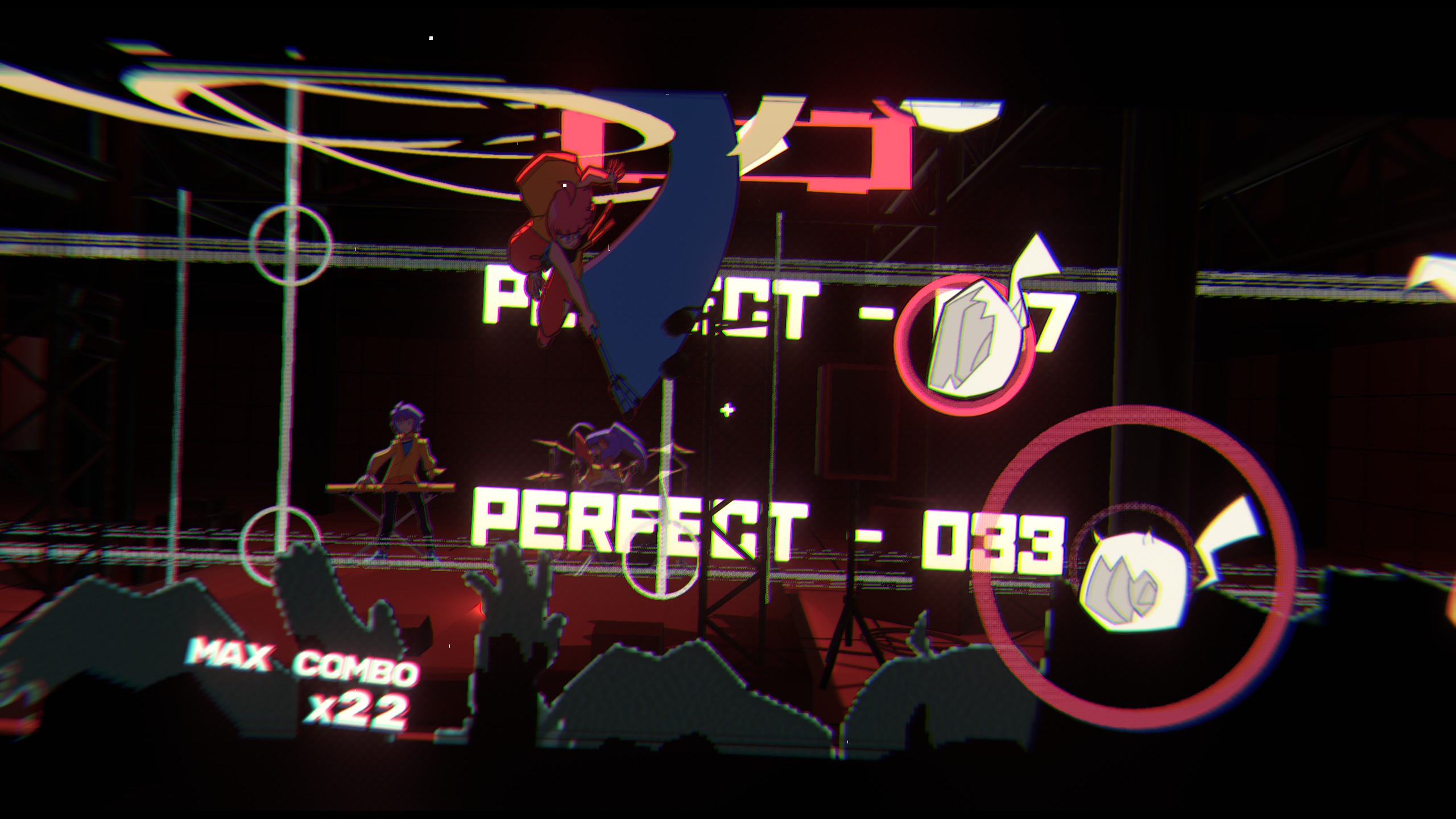
Last month I finished Unbeatable, a slick anime rhythm adventure game about playing music, changing the world, and beating up a whole lot of cops. Unbeatable is made by D-CELL games, a project nearly a decade in the making with a slowly growing team of animators, musicians, and voice performers. The journey this game took me through certainly had its high and low points, but it got me thinking a lot about what rhythm games fundamentally do and what can ultimately be accomplished by using them as a format for telling a story.
Rhythm games are, at their core, about hitting notes on a note chart. They're about skill, precision, attentiveness, reflex, and feeling the groove. When it comes down to it, the game itself could look like anything, right? Because the point of the visuals is to see the note coming so that you can hit it precisely on time. Right? That's why so many of them have options to disable visual noise and focus on the notes…
…Right?
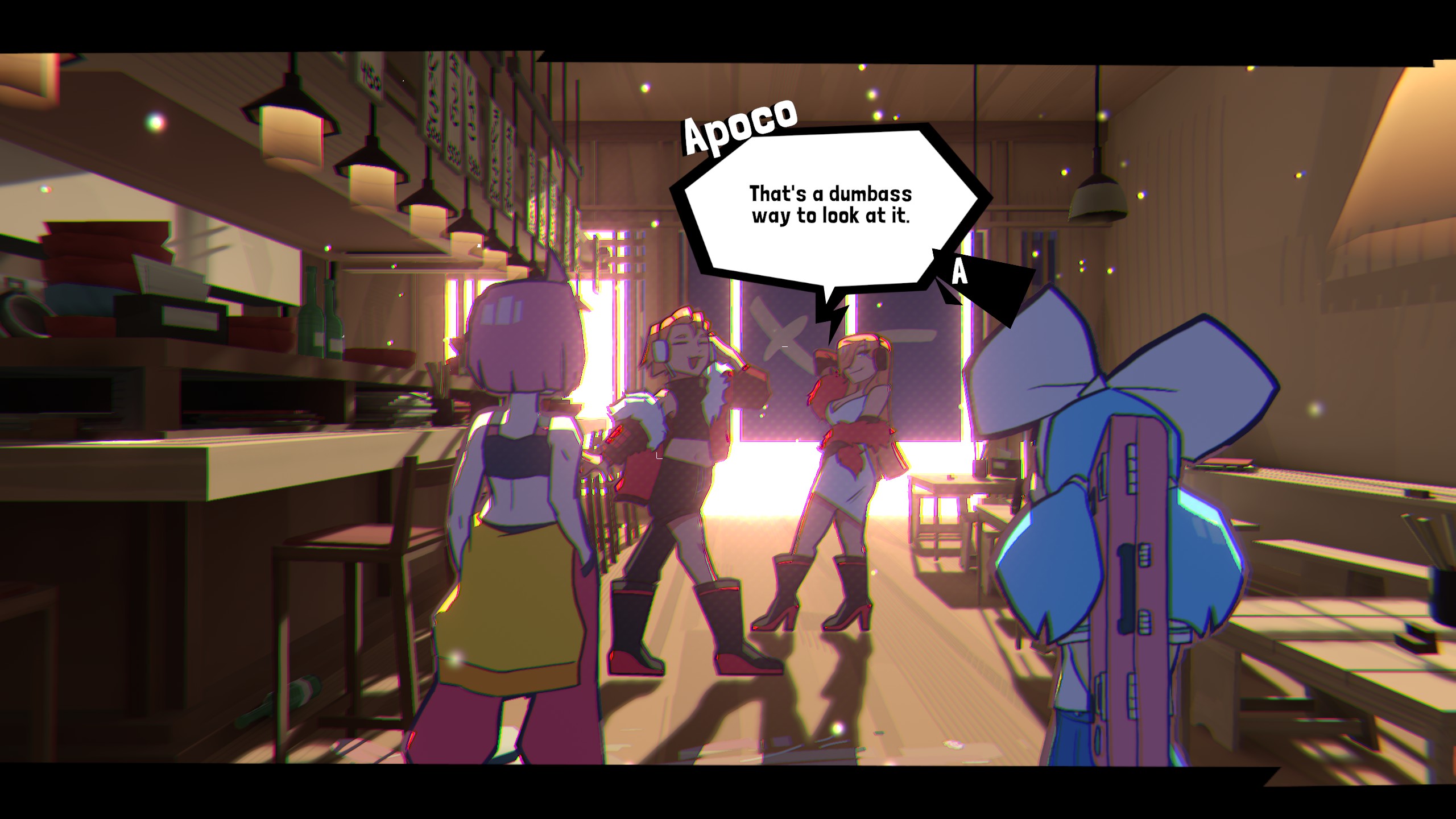
I think that’s probably wrong, actually. Rhythm games are, inexplicably but undoubtedly, about spectacle. As much as they revolve around the notes you have to hit, they build their identities around visual style elements. The throngs of cheering PS2 character models behind Guitar Hero’s note chart, the fractal abominations looming over Thumper’s pulsing industrial racetrack, and the rapping kung fu onion man trading bars with Parappa are crucial to what those games are. It's easy to imagine that it's all about the pure essence of the note chart, about the custom controllers and carefully considered mechanical interactions that intertwine with the musical style. But ever since I became obsessed with Dance Dance Revolution as a 7th grader, I’ve known that seeing what the game wants you to do isn't nearly enough. You'll never get into the groove unless you can hear and feel the beat.
So rhythm games are instead about seeing just enough visual information to time and choose your button presses and spending every other iota of your attention on hearing and feeling the music, including visualizations that supplement that act of feeling. Doesn't it make perfect sense, then, that visual style is such a memorable and important part of so many rhythm games? Doesn't it make perfect sense how we end up with the Mii-looking Trombone Champ goofballs, the Sayonara Wild Hearts masked motorcyclists?
Rhythm games are at their core about beautiful distractions. You can already hear the music. You could listen to the music with no visuals at all, if you wanted to. And it only takes so much visual information to tell you what button to press next. Everything else, every other detail, is about building a kickass music video to accompany your kickass performance, to make you feel the music even harder, and maybe even to tie it all together into the story that the music is trying to tell.
I suspect that Unbeatable's developers agree with my interpretation, because the game is perhaps more committed to visual spectacle than any other rhythm game I've played. Many of the rhythm sequences in its story mode are essentially bespoke music videos that accompany the track and help deliver the scenes of the story, often the most dramatic or action-packed ones. They’re amped-up fight scenes and melancholy dream sequences. They’re chaotic chases and triumphant live performances and nail-biting escapes.
The music in Unbeatable is a love letter to alt rock, garage bands, anime, and anything would make you dance or sing or cry cathartically when it plays on your iPod through your wired earbuds. Its tracks are often woven with playful electronic flourishes but the vocal and guitar performances feel a little scrappier and more grounded. It's blatantly inspired by late 90s anime, FLCL looming largest among the bunch, but its subtler influences are broader, and some tracks have the energy of modern "bedroom musicians" that feels simultaneously experimental and nostalgic.
Unbeatable is also a game that's diegetically about music, if that wasn’t obvious. It takes place in a world where (to quote the game’s own marketing) “music is illegal… and you do crimes.” Specifically, Unbeatable is about how playing music makes you feel things, and how feeling things makes us all too passionate and willful to be quiet citizens and obedient laborers, and how ultimately we need to feel things to be human.
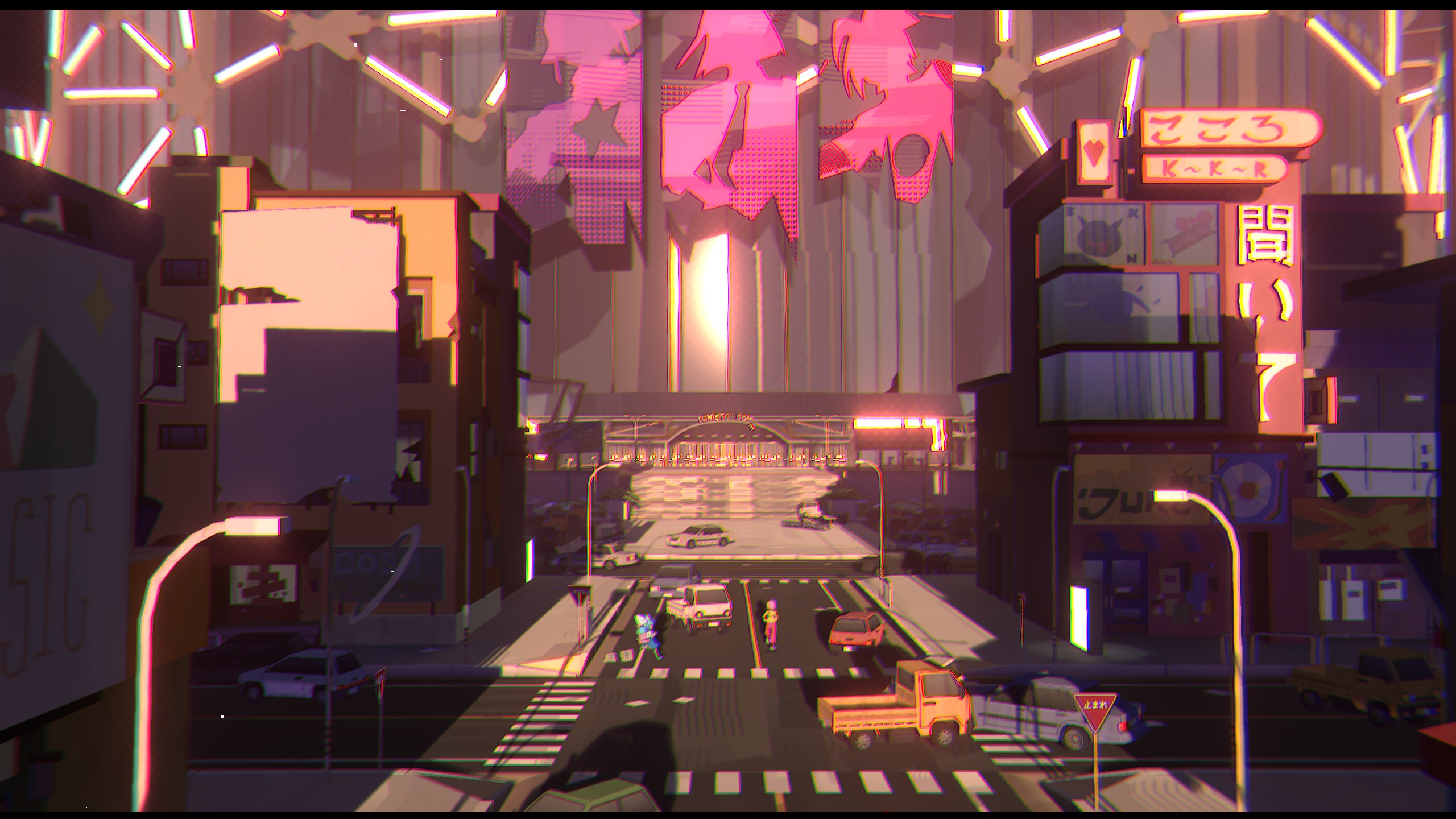
When Unbeatable isn’t supplying players with rhythm game challenges, its storytelling operates within a lightweight adventure game format, in which heroine Beat runs around sunset-drenched towns and city blocks, solving problems and and talking to people. The game goes out of its way to do a thing that a lot of narrative games don’t do: frequently, it makes multiple characters’ voiced dialogue deliberately overlap and interrupt each other. We’ve all seen RPG dialogue sequences with silly pauses between supposed interruptions and the lines they supposedly cut off; it’s a signature identifier of video game dialogue rhythm. Unbeatable puts in the effort to engineer it's way out of this common shortcoming because the rhythm and spectacle of its conversations hold weight within the experience in the same way its musical action sequences do. It relies on dialogue rhythm for comedy and drama, to complement and heighten the voice performances and the writing that buoys them. If a pure, abstract note chart can’t speak for itself, neither can a pure, written script speak for Unbeatable. Performance is too important to leave behind.
Oddly enough, as a more typical kind of rhythm game, Unbeatable doesn't really hold my attention. The ways in which it escalates difficulty have a lot more to do with visual processing than auditory, which is interesting at first but unsatisfying when I amped up difficulty and tried to push my skills further in the the arcade mode. That said, the “hard” difficulty that I selected for the story (the suggested default), was challenging in a fruitful way: it kept the tension high during those dramatic story sequences and even pushed me hard enough to run into close calls and brutal game overs.
The story of Unbeatable is frequently funny and often heartfelt, though it perhaps spends too much energy on high-concept sci-fi ideas that don't cohere into strong metaphors. The ending is awkwardly paced but has a lot of charm and strongly felt sincerity. The combination of big conceptual ideas and several dreamlike sections at the end left me struggling to parse how much was unclear on purpose and how much was unclear by accident. It ultimately comes together into a very vibes-based finale, dripping with more intimate melancholy and grief and hope.
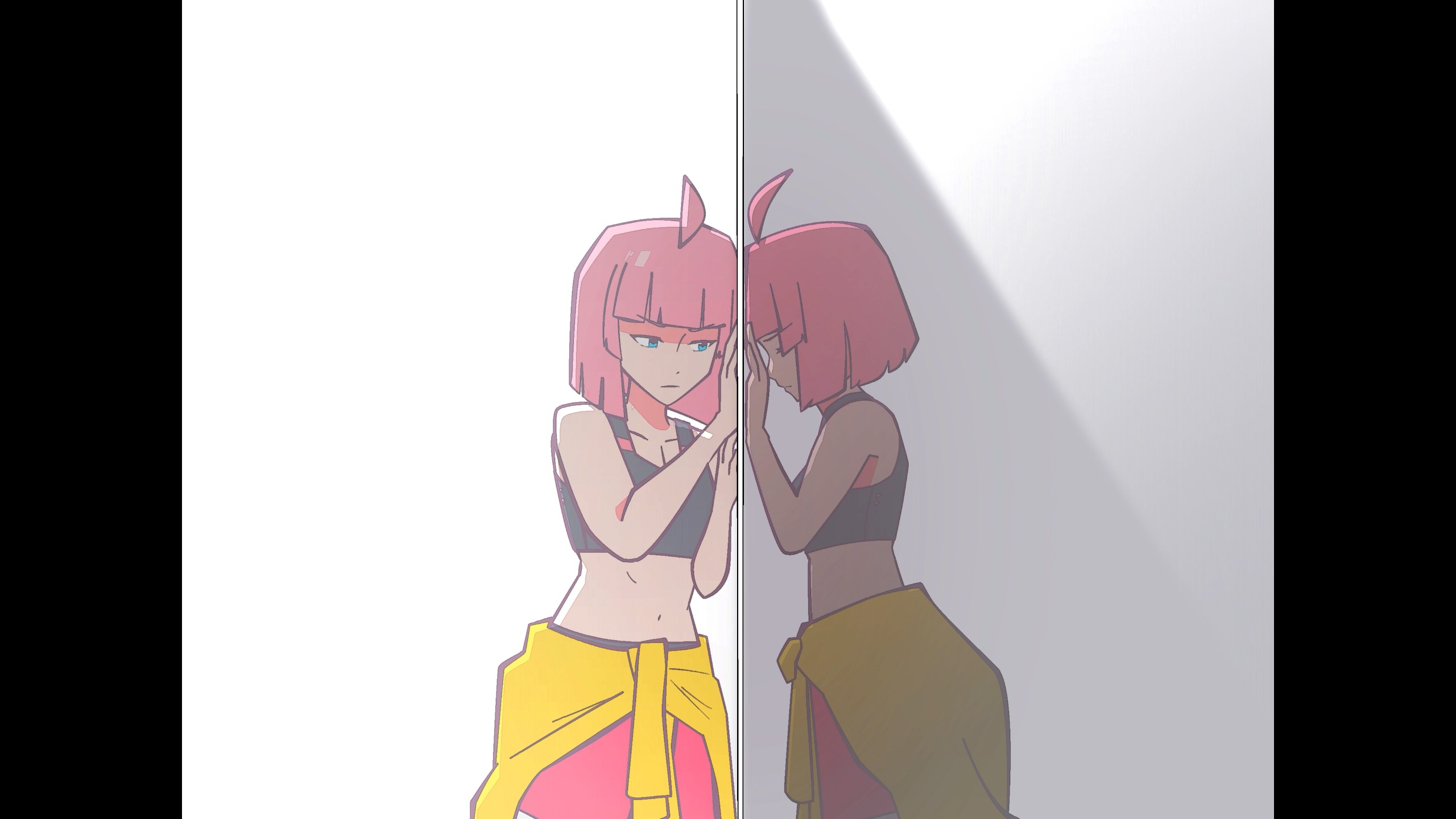
These close examinations of ennui and grief, of being stuck in a rut as you pursue art and constantly get in your head about your motivations, it honestly... it hits. It’s sometimes clumsy, and it’s a little long in the tooth, and sometimes it’s sentimental in a way that doesn’t work for me at all. But even when it's trying too hard, it tries too hard in a way that's difficult to be mad at. The emotions behind its writing, the vocal performances, they're all soaked in enough genuine feeling that the meaning comes through even when storytelling falters. Finishing this game made me want to play music. There are tons of video games that have incredible music that means a lot to me, but they don't make me want to play music.
Unbeatable makes me want to play music. It's approach to telling stories about music, using everything in its animation and art and writing arsenals to do so, is a big part of making me feel that way. I have a lot of minor complaints about its overall construction but at the end of the day, all it's trying to do is leave you with a feeling. And it fuckin' does it.