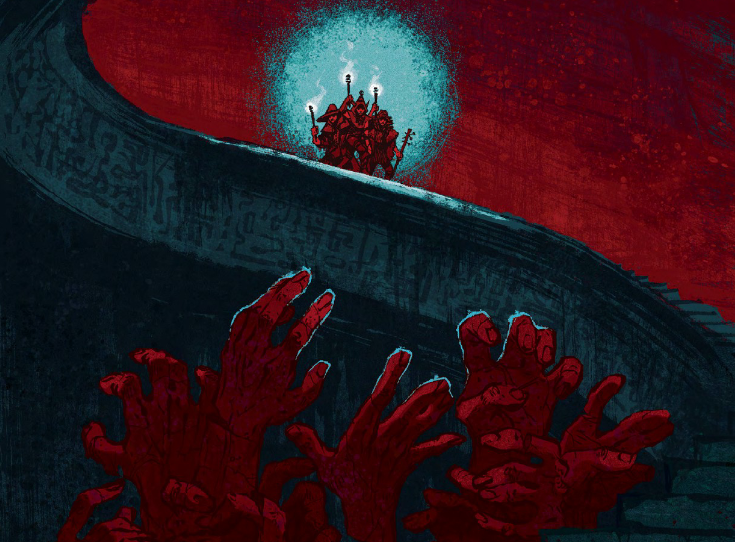
Last week, I reached the conclusion of a long campaign of Heart: The City Beneath, by Grant Howitt and Christopher Taylor. My group played on-and-off for a year and a half, and wrapped our story after 31 sessions (each averaging 2-3 hours).
That’s longer than Heart’s own rulebook recommends. There are places where we stretched the system’s limits, or at the very least its novelty. But it mostly served us quite well, evolving to meet the changing stakes and injecting interesting details via new abilities.
I don’t have a big thesis about what Heart is or does, at least not much more than what I wrote a year ago when we were 9 sessions in. Instead, I’ve put together a retrospective: I’ll share some bits of storytelling at my table that sticks with me, I’ll discuss Heart as a system and a setting, and I’ll reflect on what it taught me about my GMing style and how I’d like to evolve and challenge it in the future.
The Story We Told
Heart: The City Beneath takes place in the sprawling and unmapped caverns beneath the megacity of Spire, surrounding an inexplicable reality-warping thing at its center called the Heart. Our story began with a motley crew of misfits and wound its way to being a tale about gods and those they seek to control. But first, let’s introduce our cast.
The moral grounding of our party was Eolin, a Drow and a member of the Hounds, a loose organization of badge-carrying peacekeepers whose powers are tethered to the doomed regiment of soldiers that first unleashed the strangeness of the Heart itself. Eolin inherited the badge from her partner, who had paid with her life for rebelling against the mysterious forces that govern the Hounds. Eolin believed in providing protection and aid for regular folk, and hoped to earn penance as a new member of the Hounds after their leadership took away her partner. Her story revolved around themes of identity, how we emulate those we look up to, and institutions and the power they wield.
The forward drive of the party came from Tomahs, a human academic who tired of the sterile halls of academia and—okay fine, he was kicked out. Tomahs had become obsessed with the Vermissian, the failed Spire subway network that became extra-dimensional and reality-warping when it intersected with the Heart. He became a Vermissian Knight, grafting salvaged tech onto his body to augment himself and prepare to delve into the depths of the Heart’s wilderness in search of more answers.
The chaotic element of the party was Jo’ankh, a well-traveled gnoll who found his way to the Heart in search of purpose and answers to his many questions about free will. Jo’ankh was a magical tinkerer known as a Junk Mage, and he knew the many forms and facades of ancient gods and how to invoke them to grant him power. He felt the Heart’s pull on him, but could never be quite sure whether his own strangeness was born from it or from within. In any case, he wished to understand the Heart better and maybe even become a part of it.
The rulebook for Heart defines Landmarks as destinations worth exploring, which may contain all manner of things. Some Landmarks are Havens, communities where rest, recovery, and company are available. Our adventure began at the base of Spire with a journey to Grip Station, one of the prewritten Landmarks in the book, where a vast growth of glittering crystal stalactites hangs above a precarious old railway station.
Beyond there, I was immediately compelled to write my own Landmarks. The book is full of flavorful setting options to choose from, but writing my own was some of the most fun prep I’ve ever gotten to do. Here are a few Landmarks I’m proud of:
- Brindlewrithe — a town built in the center of a nest of millipedes the size of buses; hostile wildlife is kept at bay by the labyrinthine entrances and exits to town, formed by tunnels in the gaps between slow-moving living millipedes that swarm around it in a great writhing nest. The town’s buildings are tightly packed and built from clay, stone, and recovered millipede husks.
- Ustus, the Collector — a gargantuan snail-like creature who crawls the tracks of the Vermissian and attaches train cars to his own ever-growing length. He is a monstrous living train who mind-controls and enslaves his passengers, who then work to attach the latest train cars (or approximations thereof) that he collects from the endless realities pierced by the Vermissian. I wrote some tables and rolled dice to generate each subsequent train car when the players were exploring i.
- Doldrum — a town that suddenly and inexplicably sunk into the mud five years ago and later emerged somewhere else entirely: upside down, askew, and with its inhabitants having lost all memories of who they were. Now, they’ve fall into the lives they could assemble from context clues, awkwardly settling into marriages and jobs, figuring out how to reinforce their houses before they sag further, and trying to get their bearings. Some have found themselves dissatisfied, adrift, or even imperiled by their inherited lives and loved ones. Many have turned to the guidance of a new cult in town…
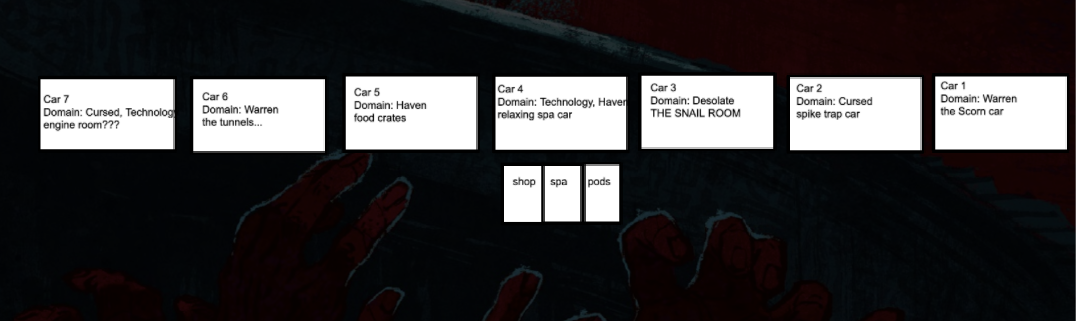
Over the course of the game, the players learned that the Hounds were guided by a godlike gestalt consciousness formed from the lost regiment to which the original Hounds belonged. Soon, the players encountered the horrific train creature I mentioned above, another godlike being, and decided they needed to destroy it. Before long, one character was afflicted with The Ravening Call, a distant howling of a strange beast in the back of his mind; what began as mere Fallout (Heart’s narrative-heavy consequences for accruing too much Stress from rolls) gradually evolved into a parasitic deity itself. The party met a mysterious and wealthy hunter from the surface who delighted in the idea of slaying gods, and had come deep into the heartlands to accomplish just such a feat.
When the party encountered the train, Tomahs’ obsessive curiosity drew him to climb aboard despite various indications of incredible peril. While there, he found that a godlike creature whom he hoped to have affinity with was in fact a monstrous mind-controller and insatiable pillager of salvaged tech, a grim mirror of his own ambitions towards the Vermissian and its potential. It was here that his resolve was cemented: the Heart and the strange things it disgorges ought be studied, understood, and then controlled in pursuit of the betterment of society—and a cure to a disease that afflicted his own family.
Halfway through the campaign, Jo’ankh acquired an ability called “Greed of the Red King” and took an additional sub-ability called “A King Demands.” It reads as follows: “Once per session, you can demand that a target holding any item gives you that item, and they must obey.” This became an incredible source of both comedy and narrative momentum, culminating in a moment in which Jo’ankh commandeered a crowd of cultists by climbing onto a soapbox, delivering a rousing speech, and demanding the priest’s robes off his own back. Per the ability, the priest immediately complied; how could Jo’ankh not have won the crowd’s favor?
Eolin pursued her Zenith beat, a mechanism in Heart that grants players an ability that can perform impossible feats in exchange for the sacrifice of their character. Her story ended with her gradually transforming into her own lost beloved, and using the power of the Hounds to protect a town in turmoil from a colossal external threat. Eolin dissolve into the gestalt consciousness of the fallen regiment, but her actions gave the town the time and safety to survive the threat and begin rebuilding their fractured community.
Playing Heart
We did find a rhythm with Heart after a while, but we also found quirks and snags. Heart often feels very swingy due to the variance of single die rolls. An enormous effort to strike a dangerous beast with a powerful weapon could still roll a 1 on that weapon’s damage die and be of little use. Efforts to traverse treacherous places, systematized in heart as Delves (with a number of points to clear based on player actions), could be similarly stalled by low rolls. On the other hand, when players fail or succeed imperfectly, they incur Stress; every time Stress is gained, there is a growing possibility of Fallout, a big menu of flavorful consequences that often have narrative implications and sometimes have severe mechanical ones. The amount of Stress gained is another tyrannical single die roll, the outcomes of which can be similarly cruel; in one especially dramatic situation, a truly staggering run of bad luck at the hands of a single action roll caused the partial destruction of an entire town along with the capture and imperilment of the whole party.
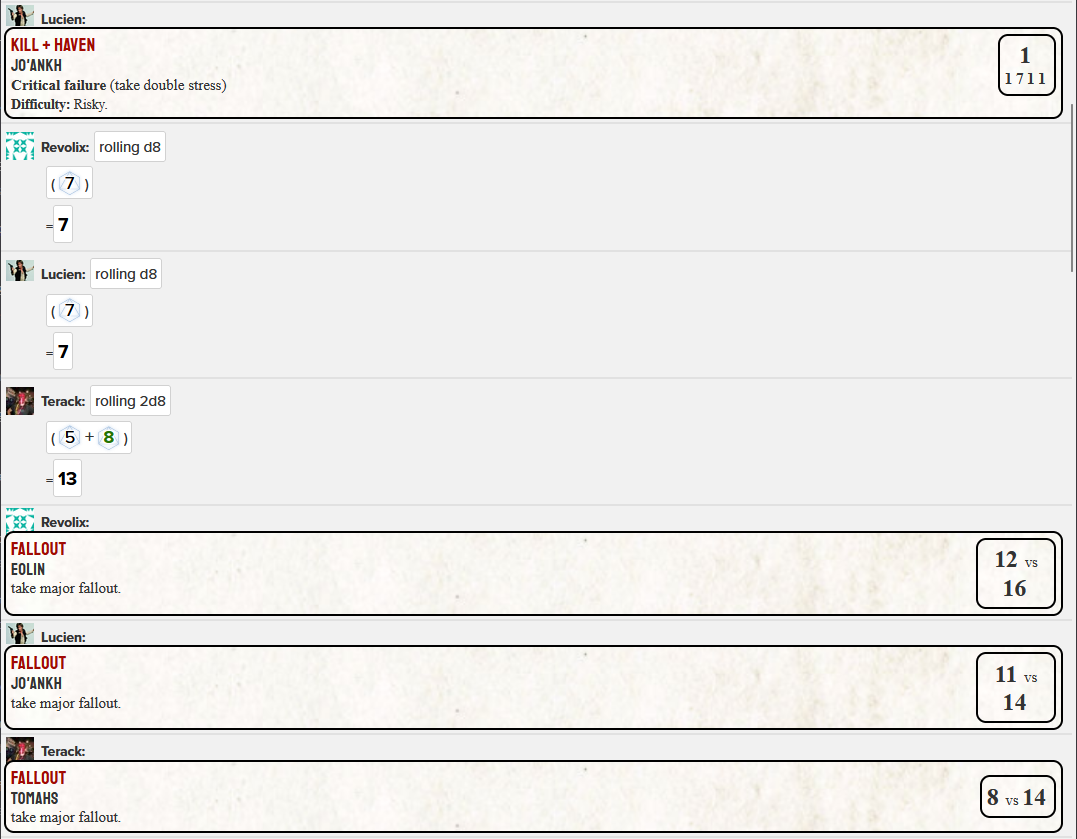
There is a lot of thematic value to the feast-or-famine nature of these damage and effect rolls. Everything is strange in the world of Heart, and sometimes it feels like forces outside your control conspire with or against you. Rolling with the punches and letting swingy dice rolls guide the story can be fun, but sometimes it’s infuriating when careful choices to spend precious resources are utterly inconsequential. Often, it feels like players have to get lucky after a good roll or a thoughtful sacrifice of resources.
Default rolls are fairly easy to succeed at, but the GM tool for increasing difficulty is a stark one; it can quickly make obstacles or adversaries seem nearly impossible to contend with. On the whole, the brutal difficulty is both flavorful and fun, but it’s something to wield carefully as a GM if you don’t want to essentially wall players out of any hope of a good outcome.
Our campaign ran pretty heavy on the Stress and Fallout, to the point where Fallout sometimes felt too frequent and I was inclined to hand out less troublesome Fallout options. Even when I made sure players had a lot of resources and access to Haunts (where they can remove Stress and Fallout), I quickly found them were more inclined to save resources and wait for Fallout rather than to use them to heal Stress and roll a 1 if their luck abandoned them.
That said, there was a lot of good that came from this unpredictability. The few times the party fought other people (rather than strange monsters) felt tense and dramatic, with real stakes to any move they made. Even with shorter sessions, the pace of these core mechanics meant that a lot happened in any given session and the story kept moving forward. It’s an appropriate fit for a setting that’s unpredictable and often centers greed, hubris, and encounters with unknowable beings and forces. It helped me get in a headspace where I could emphasize core thematic elements of the game (namely, the feeling of being caught amidst forces beyond your understanding) without feeling completely unfair.
Reflections
Running Heart helped me improve on some of my most boring GMing habits, but it also brought them into starker relief. Thanks to Stress and Fallout, I had express permission to push hard against players when Fallout happened rather than pulling punches. But it also produced a reliance on Fallout to deliver consequences, when in fact some failures ought to have been more trouble in and of themselves. It’s hard to judge my leniency too harshly, because the players did have some truly abysmal luck, but I also wish I’d leaned into disaster more often.
The way I ran Heart made it feel a little bit more like a grand adventure than a desperate delve into the strange and upsetting (though those things were still there). Certain threads in characters’ Callings (from which they choose Beats, the narrative-driven goals that earn players advancements) drew me to explain and clarify things about the world in order to create satisfying revelations as we went. But part of me wishes I’d kept things just a little more mysterious and inscrutable. I’m proud that some ambiguity remained, especially with the intentions and graces of the strange gods of the Heart, but I also wish I’d made greater effort to complicate the easy taxonomies that categorized them as mythic gods in the first place.
Focusing on the thematic fixations of my players’ character concepts was a strong guiding force in the directions I took the story, with Beats providing some welcome extra input. I’m happy with the flexibility I brought to GMing even when putting my prewritten Landmarks and NPCs in front of players. I tend to have a hunch about what they’ll do, but they often surprise me and I’m good at playing into their curveballs.
Another thing that running Heart made clear to me is how much I gravitate towards fantastical horror, body horror, and various sorts of weird sci-fi and fantasy that come along with “zonecore” fiction like Roadside Picnic or Annihilation. I’ve had a lot of fun playing in this space with both Heart and Apocalypse Keys, and it’s a style of horror writing that I’m starting to get genuinely decent at, even when improvising. My challenge to myself would be, as before, to complicate taxonomies: I want to find ways to use a flair for horror towards broader ends.
I have a habit of losing interest in campaigns as they go on; I look for good places to end, I pick up and explore dangling threads, and then I lose interest in expanding my prep further. I have a similar reflex even from a player perspective, and sometimes even endeavor to get my characters killed or retired just for a new face and a change of pace. I like when stories end and there are a great many games I want to play, so once I understand what a game is doing and feel that I’ve gotten something out of it, I look to wind it down. Sometimes, I look too hard for an exit ramp rather than letting things play out and finding a satisfying conclusion. With Heart, we lingered longer than I hoped, but we also got to really wring a lot out of the system and feel that we’d explored our characters and playbooks deeply.
In fact, I’m really happy with our Heart campaign, and have too many interesting moments to fit into this already overlong blog post. More than anything, I’ve come to treasure the rapport I’ve built with my players and the level of trust and enthusiasm we all bring to each others’ storytelling. More than anything, it makes me excited to pitch them on new ideas and new stories.