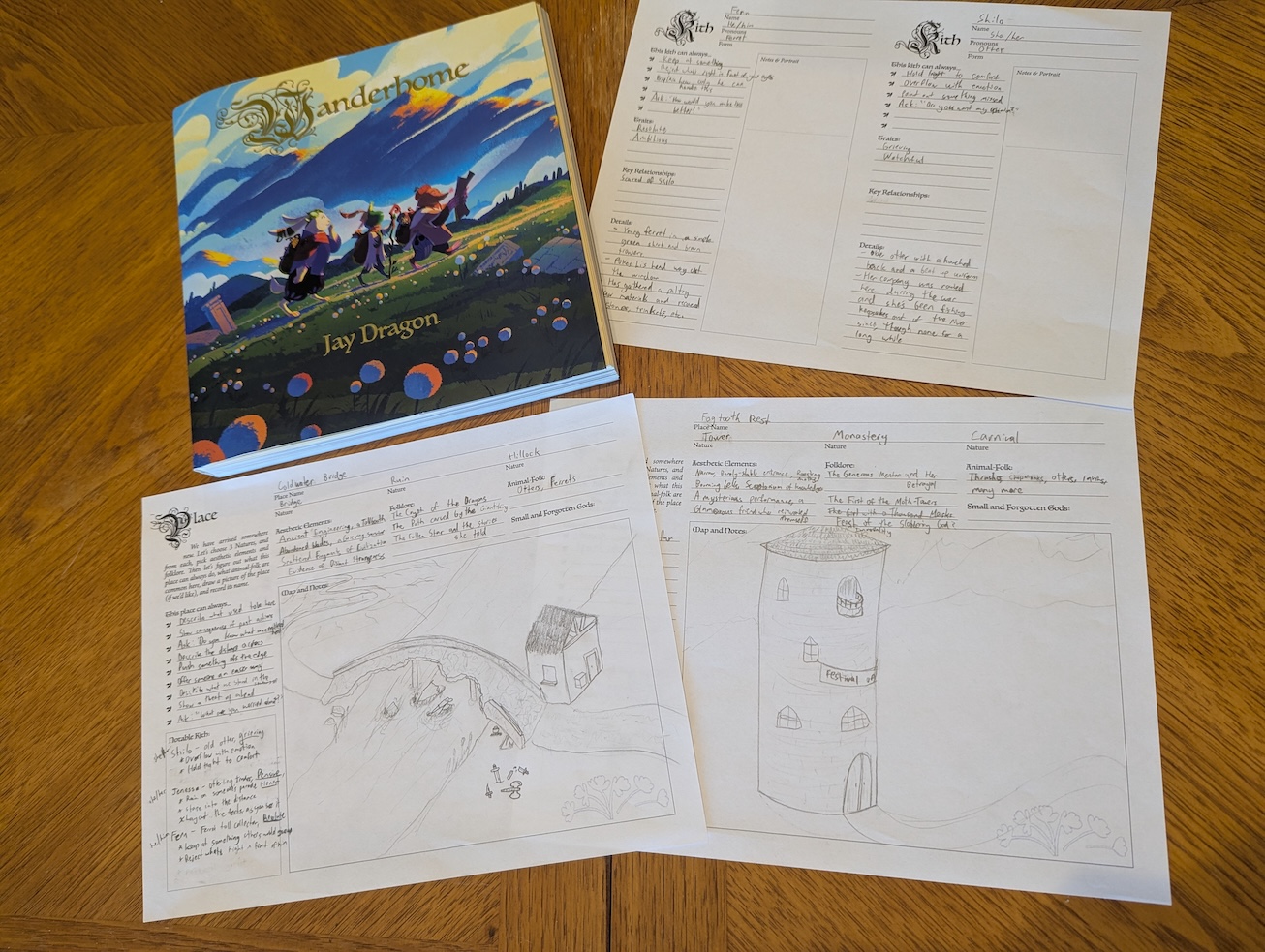
Wanderhome, by Jay Dragon, is a game I’ve only played on a few occasions. I’ve pulled it out three or four times, often as a change of pace, a one-shot with a unique tone. Last week, I got to introduce it to a new table. In preparing for it, I rediscovered not only what I love about the game, but also the ways it’s shaped my approach to prepping and running games.
Wanderhome is a game with simple rules and a subversive premise: play as wandering animal-folk in a world that has lost its taste for violence, using a system with no dice and thus no overt “failure” outcomes (unless you choose to fail at something). It’s about troubled but caring characters who both shape and are shaped by the world they explore, who travel in search of a home that they may not be able to name or define.
Wanderhome presents two ways to play: it can be played GM-less, with the table sharing responsibility for portraying the world and the non-player characters in it, or it can be played with a Guide filling a role similar to a traditional GM. The use of “Guide” as a term is a deliberate one: they may have responsibility for establishing locations and NPCs, but they do not have any fundamental authority over the world—they are simply tasked with presenting it to the players.
I’ve never played the game without a Guide, even the couple of times that I didn’t play the Guide myself. A combination of available time and the size and preferences of my play groups meant that a guided session has always been the easier choice. The game’s rules offer a simple and reasonable list of benefits for playing either with or without a Guide, many of which align very cleanly with my own reasoning.
The entire section about Guides is barely a page of text, but the structure of the game is quite well-suited to support divided responsibilities. So much so, even, that I think it provides a set of tools that could be generalizable to TTRPG prep of all sorts.
I have plenty of great things to say about how the character playbooks work, but to explore the Guide’s perspective, I want to look at the world of the game as the book defines it in a few simple components: kith, places, and seasons.
Things You Can Always Do
Before I can explain the tools for creating NPCs and places, there’s one key ingredient that unifies these building blocks with the playbooks themselves: lists of things you “can always do.” Inherited along with a number of other mechanical and writerly ideas from Avery Alder and Benjamin Rosenbaum’s Dream Askew, Dream Apart, these words are present in every playbook as well as the Traits and Natures that inform the world of the game.
In the playbooks, these options are framed as “some things you can always do” and help to reinforce each playbook’s archetype. The Pilgrim can always “Recite a small prayer”, the Ragamuffin can always “Get really invested in a new interest.” These are simple, playful instructions to players who may not always know what to do next in a game that isn't interested in clear conflicts or villains.
Crucially, though, the role they play in building NPCs and places is not so different: a helpful shorthand for the Guide to use in order to communicate what those people and places are about.

Traits and Kith
In Wanderhome, NPCs are referred to as “kith”, a word that means “friend” or “acquaintance” and is the counterpart to “kin”, meaning “family”. Just like the term “Guide” in place of something like “game master”, “kith” is a term that helps reinforce the themes and goals of the game: the characters we’ll meet in the world are, as a baseline, something like friends to us.
The rules have a brief explanation for how to create new kith. As a foundation, each kith has a name, pronouns, an animal form, relationships to other characters, and a single central detail about them. That’s a good start, but the key to defining their personality, which the Guide will be responsible for portraying, is Traits.
Traits are the building blocks of distinctive and memorable NPCs, chosen from a collection of 48 options grouped into 7 broad categories. Each Trait is a single adjective that comes with a simple set of details, usually consisting of no more than 5 sentences in total:
- A description of what the Trait means
- A few examples of the common roles or professions that characters who embody this trait might take on
- 3 options for things that kith with this Trait “can always do”, from which to choose 1 or 2

Per the rules for creating kith, they should always have at least two traits. This means they’re guaranteed to have several things they “can always do” when the Guide isn’t sure how to introduce them or how to respond to the players’ interactions. This list of options is a straightforward reference that helps the Guide find and embody that character without needing an especially deep understanding of them before play.
Traits essentially function as modular pieces of NPC personality, priorities, behavior, and habits. By choosing several, any given character can easily feel both multifaceted and vividly rendered. Despite their specificity, Traits rarely feel all-encompassing or oversimplifying, and instead form a sturdy backstop that allows Guides (or players in a Guide-less game) to play kith confidently.
Traits can help demonstrate personality (a Proper character might “Judge something for it’s inappropriateness”), ground kith in recognizable archetypes (a Witchy character can always “Cackle”), and remind the Guide how they might engage with the player characters (a Relaxed character can always ask: “Do you want to talk about it?”). I frequently gravitate towards this style of shorthand when prepping NPCs for other games: little habits and reflexes that make them unique. Building NPCs around simple prompts and reminders like this can make them similarly easy to pick up without feeling one-dimensional.
Natures and Places
A game about traveling needs stops along the road, some small and some significant, some restful and others harrowing. The world of the Hæth, as it’s called, is an expansive one full of uncountable settlements, structures, ruins, mysterious gods, and wild expanses. It’s a world recovering and rebuilding in the aftermath of a devastating war. To convey all these ideas, places are constructed from Natures.
Not unlike Traits, Natures are modular collections of descriptive language that combine to form a whole, distinct, and memorable place. Each Nature includes:
- A short description of what this place is, has, or does
- A list of things this place can always do (just like playbooks and kith)
- A list of aesthetic elements, from which to choose 2
- A list of folklore, from which to choose 1

The description establishes the core thematic ideas of the Nature. For example, a Furnace “burns hot with the force of furious and creative fire.” Regardless of what sort of place it is, we know this must be true.
The things that this place “can always do” are not unlike the same list for kith: they provide a clear and usable set of choices for Guides to invoke whenever in doubt. Importantly, they often speak equally to the metaphorical ideas of the Nature as well as the literal ones.
The options for aesthetic elements expand these themes into several possible concrete incarnations, some of which are more direct than others. For example: a Furnace could have “Ornate Glassworks” or “A Legendary Blade, Left Unfinished” or “Walls of Iron Tools” or several others, with each element providing details that inform the whole.
Each list of aesthetic elements also includes one or two options for a particular kind of kith that might be found there, including a Trait they have (like “A Mighty Smith With A Burning Grudge”, where Mighty is a Trait). Often, building a place means figuring out who inhabits it, and these elements can help create a smooth transition from the place itself to the distinctive characters that live there and reinforce the place’s themes.
Finally, the folklore options are little more than mysterious and evocative phrases, meant to plant seeds of mystery and curiosity. As a Guide, this is often where it’s tempting to write or prep more than is warranted. You might feel obligated to plan out what “The Heavenblade And Its Construction” was all about, but in my experience the stories become stronger when held at arms length, when the Guide only has an inkling of what it may mean until the players engage and ideas slide into place.
The folklore speaks to the power of dramatic writing, of dropping a few Proper Nouns and letting them simmer for a while before deciding what they actually refer to. Many of the folklore sections mention overlapping details or refer to aspects of the world that the playbooks themselves brush against. These implied connections can emerge at the table as conspicuous coincidences to be investigated further.
Perhaps the most exciting part of building places is that they are composed of not one, but three Natures in combination. Each nature may be present as a literal or metaphorical element, or even something in between. For example, a Garden is “a place where everyone has plenty and the world is overflowing with gifts.” It could very well be a literal garden, but it could also be a secluded estate that escaped the war unscathed, or even a prosperous crossroads town where neighboring villages bring gifts to vie for the favor of local merchants.
For me, this is where the richness lies: it’s difficult to describe the pure world-building delight of thinking “now hold on… is this an actual lagoon, or perhaps a metaphorical lagoon?” I haven’t used a technique like this to build places in other games, but maybe I should. Some of Wanderhome’s own Natures may already be relevant to other games and settings, though some would need their own notion of Natures. Regardless, defining the next place that that a party will encounter by stitching together all the visual and thematic ideas that I want to bring forward could be a fruitful strategy.
Seasons
The last world-building tool in the book is Seasons, which… I’ve actually never brought to the table! One-shots tend to have enough going on without them that I don’t often dig in, even if I might sometimes describe places with details that are relevant to seasons. It’s something I’d like to introduce more prominently the next time I get Wanderhome to a table.
Seasons give a distinct texture to each month and introduce holidays at the end of each season, adding new details and cultural specificity to the places that the wanderers visit. They’re geared towards continuous play across several sessions, but I’m always tempted to find a way to pull them into one-shots too.
Takeaways
Wanderhome’s various building blocks are designed to be approached either by a singular Guide, who will assemble them for a table of players, or by a group of players who are comfortable with and interested in building the world together. In both cases, it’s helpful to have a distilled bit of easily-referenced guidance for how to portray places and characters that might come up.
The playsheets that are officially available tend to demand a lot of transcribing. For characters, there’s one generic playsheet rather than custom ones for each playbook. In the case of places and kith, a Guide (or a Guide-less table) will need to scour the Traits and Natures sections of the book to put together the whole picture.
On some level, this is a real inconvenience: copying whole sentences onto the page so that you can remember their (meaningful) phrasing can be tedious. When playing without a Guide, I could imagine this dragging down the pace at the table. For prep, though, and even for character creation at the table, I found the act of transcribing to be a helpful way to internalize the important details.
Overall, the ingredients used to to create characters and kith and places have a little bit more to them than you may actually need. Places in particular can feel like they have a lot going on, but at the end of the day, all of these components tend to cohere enough to feel specific and vivid. You may not be able to explore each Nature’s folklore element, but as a Guide, even the act of choosing and transcribing one of them may inflect the way the you imagine and describe the place.
To me, this breadth of available details to draw on is what makes these such potent tools for prep and play. In Wanderhome, I can build a sheet full of interesting details for a place or a character and 80-90% of them come up in play; that’s pretty efficient prep! Whether I meant to or not, I’ve already internalized parts of Wanderhome’s approach to creating kith; maybe even beyond the game itself, there’s even more I can learn from its tools for building settings.