A crucial part of the soul of modern tabletop games is uncertainty. We use it as a way to surprise ourselves and each other at the table, to buck against predetermined stories and foregone conclusions by saying “maybe, just maybe, I could do something unpredictable and get away with it.” It’s what brings the format from traditional storytelling to improvised and collaborative storytelling. I’m by no means an expert or a scholar on this topic, but I’ve been thinking about it lately as I’ve tried to stretch my design ideas beyond well-established techniques.
Those classic techniques have staying power for a reason. Dice and cards are centuries-old tools of randomness and uncertainty and, therefore, excitement. Time-tested as they are, it’s no wonder that they’re cornerstones of tabletop gaming. Things like rolling skill checks or drawing cards to tell us how a proposed action resolves are great ways to stoke our imaginations, lead us to unexpected outcomes, or cause us to reconsider tricky problems.
In story games, we often get uncertainty from each other (sometimes in addition to the above). When it’s my turn in Fiasco by Jason Morningstar, I can choose to establish the scene around my character while leaving the outcome (negative or positive) up to my fellow players to decide. Alternatively, I can keep control over the outcome but be thrust into whatever scene my companions establish for me. Either way, I encounter uncertainty on one end or the other, and further uncertainty arises during the scene itself through the simple act of improvisational scene play.
A great many tabletop games provide players with pools of distinct options to choose from—like a hand of cards, the hexes on a world map, or a table of prompts— in order to lean on players’ ability to mutually surprise one another with their choices (in addition to the art and writing contained in those options).
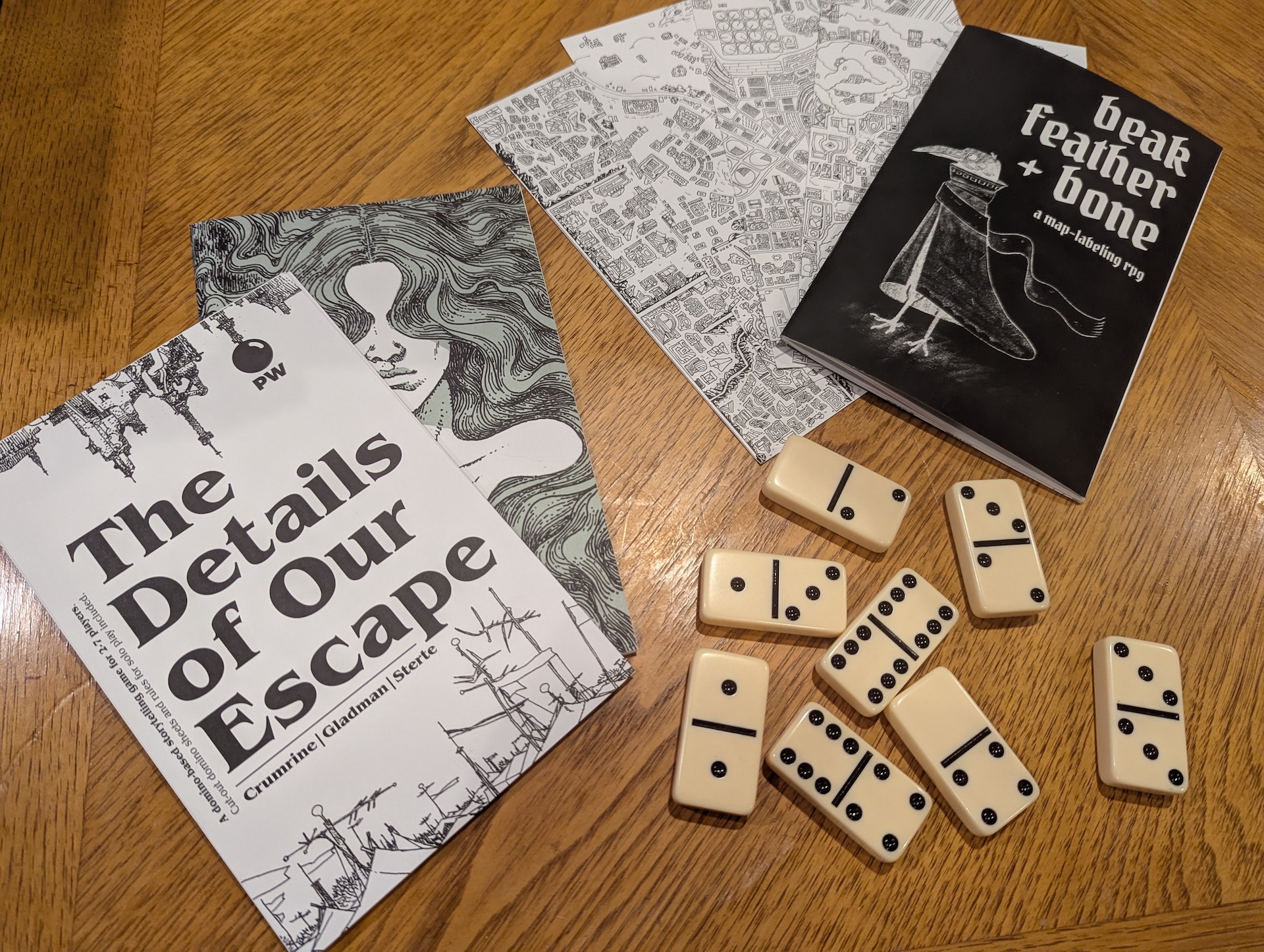
But we can go further afield than cards and dice. Designer Tyler Crumrine is especially adept at finding uncommon sources of uncertainty to build ideas upon. In The Details of Our Escape, a hand of dominoes rather than cards provides a unique offshoot of a more familiar kind of uncertainty. Dominoes are tactile in a distinct way from that of cards, and they’re also relational to one another, placed in certain configurations based on their numbers. The dominoes form a shape, a path that traces the journey’s twists and turns, making them a thematically resonant choice in addition to an eccentric one.
In Beak, Feather, and Bone, Crumrine uses simple playing cards provide a source of random prompts, but each turn is punctuated by the player selecting and coloring in a building on an illustrated map that accompanies each playthrough. That building is then described according to its significance to the faction within the city that the player controls. They might choose the building based on its shape or size or design or location, but it’ll always be uncertain to their fellow players and it will ultimately intersect with the stories that those players are telling about their own factions. The map functions almost like a table of prompts, in a way, but with visual and spacial meaning instead of words.
Another way to create uncertainty is to build pools of possible outcomes at the table and then either choose or randomly draw from them. In my game Dump Stat, players provide a set of mad-lib style words (nouns, verbs, adjectives) for the GM to secretly choose from. Those words become the stats that the players are using as they take on challenges and try to figure out what exactly they’re good at. One of the inspirations for this design idea was Tyler Crumrine’s Scene Thieves, in which players each contribute zany props to a big bag at the beginning and then draw one randomly during each scene. The prop introduces a surprising hinge point for the scene that must then be incorporated into the described scenes, but it’s also a perfect fit for the thematic setup (a troupe of actors who are also pulling off a heist behind the scenes): it grounds the story in physical objects and asks players to think about performance and theater craft while also encountering surprising and unpredictable twists, as one expects from a heist story. You could even build entire sentences of narration while drawing from a pool of words at the table, as I encountered last month in Dreamland by Jason Bradley Thompson.
If randomness or choice in general are still too boring, tests of real-life skill can be used as a mechanism for generating uncertainty. Some of the most popular versions of this (to my knowledge) use tumbling block towers to simulate mounting tension and eventual catastrophe or release, as popularized by Epidiah Ravachol and Nathaniel Barmore’s horror game Dread and used in Alex Robert’s much-lauded romance game Star Crossed.
This is all exciting and wonderful, of course, and I’m not the only one who feels this way! In fact, Brian Flaherty of Many Sided Media discusses several of these games and more in a newsletter from earlier this year. But what’s even more exciting is that the well surely goes deeper still. I have to imagine that there are all sorts of ways to derive uncertainty, randomness, and inspiration via unexpected materials and mechanics that we haven’t happened upon yet, or that exist in a far corner of itch.io that I haven’t yet stumbled upon. And in designing around those unusual resolution tools, we can lean into their specificity and evoke feelings or thematic associations that are uniquely connected to those mechanical ideas.
This notion is something that I’ve begun to dabble with in recent projects. My #promptober game WORD WIZARDS (available in its original form here, though I’m working on some revisions) relies on a test of skill I haven’t seen used before: spelling words correctly. The game is about spelling bee contestants defeating an accidentally-summoned eldritch monster by using their spelling prowess to create magical effects. With that premise, it’s hard to imagine a game that does not involve attempting to spell words. But since people have very different feelings about spelling, this mechanic risks alienating unconfident spellers. I try to mitigate this in the game's rules by building fun outcomes around success and failure, and giving players who failed some control over the resulting narrative, an outlet to turn their mistake into further creative antics. When it works, it means that a game about spelling things correctly can be just as fun and engaging for a player who’s terrible at spelling as it is for a player who wants to flex their spelling skills.
I haven't listed every uncommon resolution mechanic I'm aware of, but I'm sure there are many more that I don’t know about. If you have a favorite game that uses one, I want to know about it!